The speed and automation of cyber-attacks have increased the need for an operation-based protection of your digital assets. Nevertheless, when it comes to choosing the way to create such an operational base for your security, the decision becomes critical: should you build a physical command center or create a virtual one?
Although a command center with large screens around the room was considered the best practice, it doesn’t apply anymore to cloud-centric organizations.
This blog will help you decide whether the concept of a Virtual SOC matches your strategy and operational approach.
What Drives the Shift to a Virtual SOC?
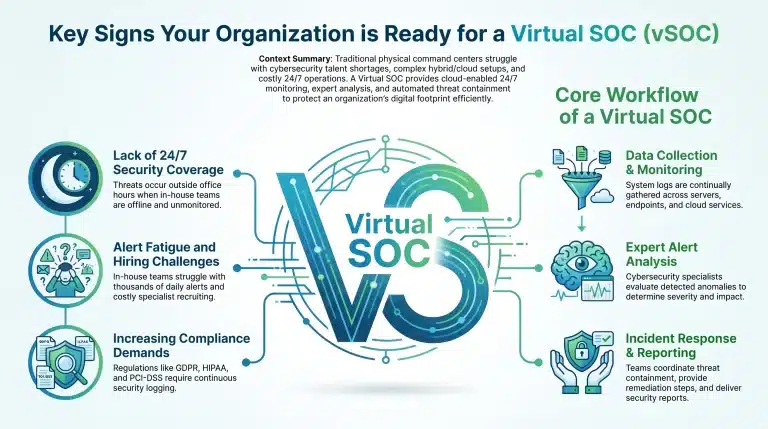
The adoption of Virtual SOC has been witnessed by various organizations owing to the difficulties involved in addressing the concerns of cybersecurity in the current distributed IT environment. Conventional SOCs generally face issues like scarcity of cybersecurity professionals, complex hybrid and multicloud infrastructure, and expensive 24/7 operations.
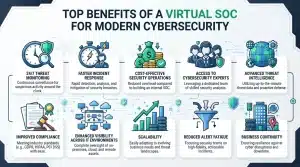
Virtual Security Operations Centers can solve the challenges mentioned above due to the following features: providing the service of real-time monitoring, access to security specialists, and more rapid deployment due to the ability to scale through the cloud technology.
How Does a vSOC Work?
A vSOC typically works via a mix of technology, security knowledge, automation, and human intervention.
- Data Collection
Security-related data is gathered from multiple sources within your IT environment such as servers, endpoints, firewalls, cloud services, applications, and network equipment.
- Security Monitoring
The collected data is analyzed on an ongoing basis to detect any anomalies and suspicious activities.
- Alert Detection and Analysis
Once an alert is detected, security experts analyze it to assess its seriousness and how much damage it can do.
- Incident Response
Depending on the model of the service, the vSOC team assists with threat containment, incident investigation, remediation recommendations, and coordination of response actions together with your IT department.
- Reporting and Improvement
The organizations are provided with security reports, security incidents, and information which may assist them in improving their security situation.
Signs Your Organization May Need a Virtual SOC
In case your company experiences increasing security concerns without the capability to monitor all day long, a Virtual SOC is an ideal option for you. The below indications will determine whether you need a Virtual SOC or not.
You Lack 24/7 Security Monitoring
Cyber attackers do not follow standard office hours. If your security experts only monitor systems during office hours, then threats might remain unnoticed for long. With a Virtual SOC, you will have 24/7 security monitoring.
Your Security Team Is Overwhelmed
The IT system today generates thousands of security alerts daily. If your in-house team is facing challenges such as fatigue with alerts, lack of resources, or inadequate visibility, then you can use the services of Virtual SOC to assist them with their tasks.
You Face Growing Cybersecurity Risks
Companies that deal with critical information like customers’ personal data, financial data, health-related data, and intellectual property rights often become victims of cybercrimes.
Compliance Is Becoming More Complex
The regulatory requirement like GDPR, HIPPA, PCI-DSS, ISO 27001, and SOC necessitate that there should be security controls in place. vSOC can help in this regard as it will provide continuous monitoring and logging.
Hiring Security Talent Is a Challenge
The cybersecurity workforce shortage is affecting businesses across the globe. It is tough and costly to hire qualified SOC analysts, incident response team members, and threat hunters. With a Virtual SOC, you can get access to qualified security experts immediately without having to go through the process of hiring.
Strategic Checklist: Is It Time to Make the Move?
If three or more of the following challenges sound familiar, your organization should seriously consider adopting a Virtual SOC. The following concerns typically suggest areas that are lacking in terms of security and may pose future cyber risks.
- We do not have the capability to monitor our security alerts on nights, weekends, or holidays.
- Our security alerting process is suffering from “alert fatigue” due to high alert volumes.
- Our infrastructure is rapidly shifting into public or multi-cloud infrastructure (e.g., AWS, Azure, Google Cloud).
- The hiring of tier-3 cybersecurity professionals is using up too much of our recruiting budget.
- We need to prove we have continuous threat monitoring in place to pass upcoming compliance audits.
Conclusion
The choice between setting up a physical command center or adopting the Virtual SOC depends on how flexible and scalable you want your security system to be against how much physical set-up costs you. As for today’s organizations working in multi-cloud ecosystems, dispersed teams and evolving threats, the Virtual SOC ensures you have everything that will provide maximum-level security but with no need to set up a physical command center. By collaborating with IBN Technologies, your organization gets 24/7 monitoring, automated threats containment and professional cybersecurity experience to cover your whole digital footprint.
Partner with IBN Technologies to gain 24/7 threat monitoring, faster incident response, and enterprise-grade protection with a scalable Virtual SOC solution. Contact us today to get started.
Need Managed SOC and SIEM Services for your 2026 project?
Get a free consultation with our tech team — no commitment.
Frequently Asked Questions
It is a cloud security solution which is a replacement of traditional physical command centers. It combines real-time monitoring, automation, and cyber experts working remotely to protect the distributed IT environments round-the-clock.
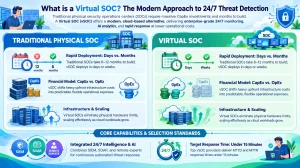
In comparison with the physical SOC which implies the allocation of physical space, walls with screens and on-site personnel, the vSOC works in the cloud, can be deployed easily and quickly, and it is cheaper than traditional SOC.
The functioning of vSOC includes 5 critical stages: data collecting, continuous security monitoring, alert detection and analysis by the experts, incident response/threat containment and security reporting to improve the situation further.
It helps to meet the requirements of standards including GDPR, HIPAA, PCI-DSS, ISO 27001, and SOC 2 through continuous monitoring, logging and audit-ready security reporting.