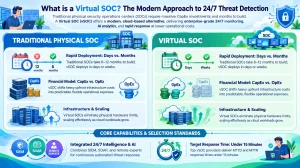
A Virtual SOC (Virtual Security Operations Center) provides organizations with 24/7 threat monitoring, faster incident response, and access to cybersecurity expertise without the cost and complexity of maintaining an in-house Security Operations Center.
As cyber threats continue to evolve, businesses need continuous visibility into their digital environments to detect and respond to security incidents quickly. However, building a traditional SOC requires significant investments in infrastructure, security tools, and skilled personnel. A Virtual SOC addresses these challenges by delivering enterprise-grade security operations through a scalable, cloud-based model, making advanced cybersecurity accessible to organizations of all sizes.
What is Virtual SOC?
A Virtual SOC is a remotely managed security operations center that continuously monitors networks, endpoints, cloud environments, and applications for potential cyber threats. By combining advanced security technologies, threat intelligence, automation, and expert analysts, a Virtual SOC helps organizations strengthen their security posture while reducing operational overhead.
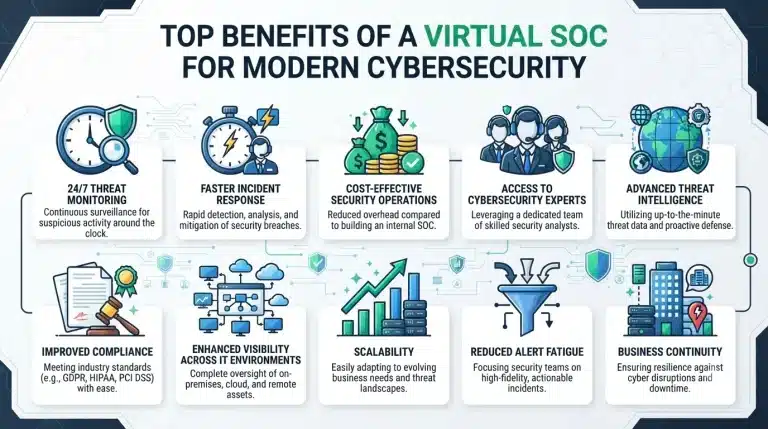
Top Benefits of a Virtual SOC for Modern Cybersecurity
- 24/7 Threat Monitoring and Detection
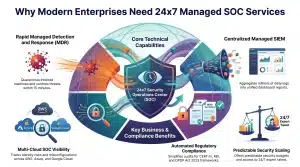
Cyberattacks can occur at any time, including nights, weekends, and holidays. A Virtual SOC provides around-the-clock monitoring to detect suspicious activities and potential threats in real time. Continuous surveillance helps organizations identify security incidents early and minimize potential damage.
- Faster Incident Response
The longer a threat remains undetected, the greater the impact on an organization. Virtual SOC teams continuously investigate alerts and respond to incidents quickly, reducing Mean Time to Detect (MTTD) and Mean Time to Respond (MTTR). Faster response times help contain threats before they escalate into major security breaches.
- Cost-Effective Security Operations
Building an in-house SOC requires significant investments in infrastructure, software licenses, and cybersecurity professionals. A Virtual SOC eliminates these upfront costs by offering a subscription-based model, enabling organizations to access enterprise-grade security services at a predictable cost.
- Access to Cybersecurity Experts
Finding and retaining skilled cybersecurity professionals remains a challenge for many organizations. A Virtual SOC provides immediate access to experienced security analysts, threat hunters, incident responders, and compliance specialists without the burden of recruitment and training.
- Advanced Threat Intelligence
Virtual SOC providers leverage global threat intelligence feeds to identify emerging attack techniques, malicious indicators, and vulnerabilities. This proactive approach helps businesses stay ahead of evolving cyber threats and strengthen their defenses.
- Improved Compliance and Audit Readiness
Organizations operating in regulated industries must comply with standards such as HIPAA, PCI DSS, GDPR, ISO 27001, and SOC 2. A Virtual SOC supports compliance initiatives through continuous monitoring, log management, security reporting, and audit-ready documentation.
- Enhanced Visibility Across IT Environments
Modern business environments often include on-premises systems, cloud platforms, remote users, and third-party applications. A Virtual SOC centralizes security monitoring, providing a unified view of security events and risks across the entire IT ecosystem.
- Scalability to Support Business Growth
As organizations expand their infrastructure and digital operations, security requirements become more complex. A Virtual SOC can scale seamlessly to accommodate additional users, devices, cloud workloads, and business locations without requiring major infrastructure investments.
- Reduced Alert Fatigue
Security teams often struggle to manage thousands of security alerts daily. Virtual SOC solutions leverage artificial intelligence, machine learning, and automation to filter noise, prioritize critical alerts, and reduce false positives, enabling security teams to focus on genuine threats.
- Business Continuity and Reduced Risk
Cyber incidents can disrupt operations, damage reputations, and result in financial losses. By continuously monitoring and proactively responding to threats, a Virtual SOC helps organizations reduce cyber risk, maintain business continuity, and protect critical assets.
Is a Virtual SOC Right for Your Organization?
Building an on-premises security center isn’t always practical when cyber threats move at fast speeds and budgets are tight. A Virtual SOC bridges this gap by offering a flexible, cloud-native defense model designed for agility and rapid response. If your team is stretched thin trying to maintain round-the-clock monitoring, struggling to secure sprawling multi-cloud workloads, overwhelmed by constant false alarms, or working to upgrade cyber defenses without huge upfront costs, a vSOC is the right move. It merges continuous cloud telemetry, automated containment playbooks, and skilled analysts to protect your entire digital footprint 24/7.
Conclusion
A Virtual SOC delivers enterprise-grade cybersecurity capabilities, including 24/7 monitoring, rapid incident response, expert threat analysis, and compliance support, without the costs associated with an in-house SOC.
By partnering with a trusted provider like IBN Technologies, organizations can strengthen their security posture, reduce cyber risks, and gain continuous protection against evolving threats. As cybersecurity challenges continue to grow, a Virtual SOC has become an essential component of a modern, scalable, and resilient security strategy.
Need Managed SOC and SIEM Services for your 2026 project?
Get a free consultation with our tech team — no commitment.
Frequently Asked Questions
The in-house SOC is dependent upon expensive physical infrastructure, buying software licenses, and employing a dedicated internal team. A Virtual SOC offers the same level of security through the subscription-based model, reducing costs significantly.
With its artificial intelligence, machine learning, and automatic filtering, a Virtual SOC analyzes large amounts of security logs daily, cutting off any false alarms and leaving only important threats that need to be addressed.
Yes, it helps with meeting compliance standards such as HIPAA, PCI DSS, GDPR, ISO 27001, and SOC 2 by providing constant log monitoring and reporting, as well as generating necessary documentation.
Indeed, it is perfectly appropriate, as its cloud architecture enables it to scale up along with the number of employees, cloud resources, or geographic locations of a business.