The Mobile Application Penetration Testing service is among the best methods for finding security holes and fixing them before they become a business threat. Testing the mobile application, its APIs, authentication mechanisms, data storage, and back-end system ensure that your sensitive information is protected from cybercriminals.
With the use of mobile applications in carrying out core business functions and processing sensitive information, security goes beyond just the mobile app itself. A complete penetration testing approach ensures the organization identifies all potential security weaknesses.
Strategies to Strengthen Mobile Application Penetration Testing Security
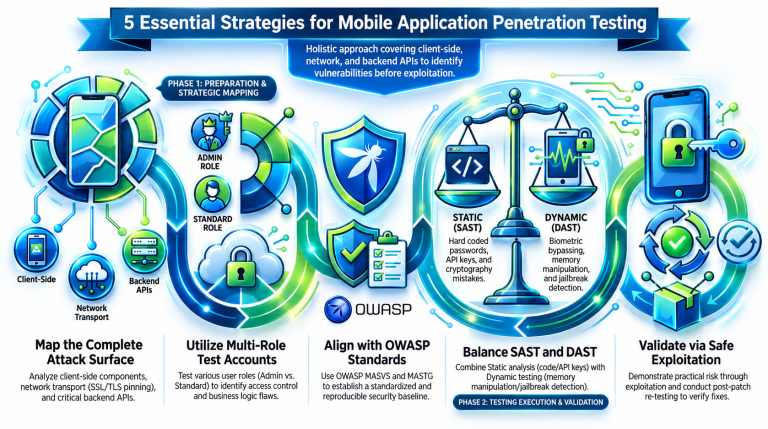
- Map Out the Complete Attack Surface
The approach for mobile security should consider all tiers of the application architecture in lieu of concentrating only on what is visible through the mobile device screen. The penetration testers should have complete visibility on client-side components such as local databases, caching, obfuscation, and deep linking. The same applies to the network transport levels where it should be ensured that there is SSL/TLS pinning, cipher strength, and good session management. Most importantly, the backend API needs to be completely mapped out during mobile application penetration testing, as major security vulnerabilities often lie at the server level.
- Prepare Multi-Role Test Accounts and Staging Environments
The limitation of testers only with basic log-in information would limit them in understanding some serious security vulnerabilities in the system such as business logic or access control vulnerability. In this regard, the security team needs to create test accounts for standard users, admin users and different tenants’ roles prior to testing. The use of diverse permissions will enable the tester to check if low-privileged users can perform cross-tenant data access or privilege escalation.
- Align Testing Strategies with Industry Standards
Conducting mobile app pentesting on ad-hoc may result in overlooking vulnerabilities for which industry standards are specifically designed to discover. The adoption of pen tests by following the OWASP MASVS (Mobile Application Security Verification Standard) will set a security baseline for both Android and iOS applications. When supplemented by the OWASP MASTG (Mobile Application Security Testing Guide), it will provide engineers with standardized and reproducible means of conducting security verification of applications.
- Balance Static and Dynamic Security Testing
Focusing on a single method of testing brings certain vulnerabilities in the security stance of any application. Static Application Security Testing (SAST) is the process of looking for API keys, hard-coded passwords, improper configurations, and cryptography mistakes in the compiled code of the application. Dynamic Application Security Testing (DAST), on the other hand, is the process of assessing the running application in terms of its authentication process, memory manipulation, bypassing biometric authentication, and detecting whether the device used has a root or a jailbreak.
- Validate Remediation Through Safe Exploitation and Re-Testing
Identifying security vulnerabilities is useful if it is put into practice. The mobile application penetration testing engineers must exploit found vulnerabilities and show their practical importance. After fixing such security problems, one should repeat testing again. Such post-patch testing is critical in mobile application security testing.
Conclusion
Mobile application security is dependent on a holistic approach that involves the client-side device, network communication, and backend API level. With the integration of OWASP standards, hybrid static and dynamic testing, multi-role testing, and verification post-fixes, companies can remove their vulnerabilities even before hackers use them.
At IBN Technologies, we provide end-to-end mobile application penetration testing in Android, iOS, and API platforms. Ascertained by our highly experienced security engineers (CEH, OSCP), we help companies identify high-risk vulnerabilities, comply with regulations, and verify the fixes so that the mobile ecosystem is always secure.
Contact our security experts today to schedule your mobile application pen test.
Need VAPT Services for your 2026 project?
Get a free consultation with our tech team — no commitment.
“`text id=”h7p4mz”
Frequently Asked Questions
Mobile application penetration testing should assess all relevant attack surfaces, including client-side components such as local storage and deep links, network communications including SSL/TLS implementation, and backend APIs.
Multiple test accounts representing different roles, such as regular users, administrators, and users across multiple tenants, help testers evaluate access controls and identify vulnerabilities involving privilege escalation, unauthorized data access, and tenant isolation.
The OWASP Mobile Application Security Verification Standard (MASVS) provides a security baseline for Android and iOS applications, while the OWASP Mobile Application Security Testing Guide (MASTG) provides guidance and techniques for conducting mobile application security testing.
Static testing involves analyzing application code or binaries without executing the application to identify issues such as hard-coded secrets and insecure configurations. Dynamic testing evaluates the application's behavior at runtime, including areas such as session management, jailbreak or root detection, authentication mechanisms, and biometric controls.
“`