When assessing security risks, business leaders often ask about Ethical Hacking vs. Pen Testing: what is the difference and which service does an enterprise need?
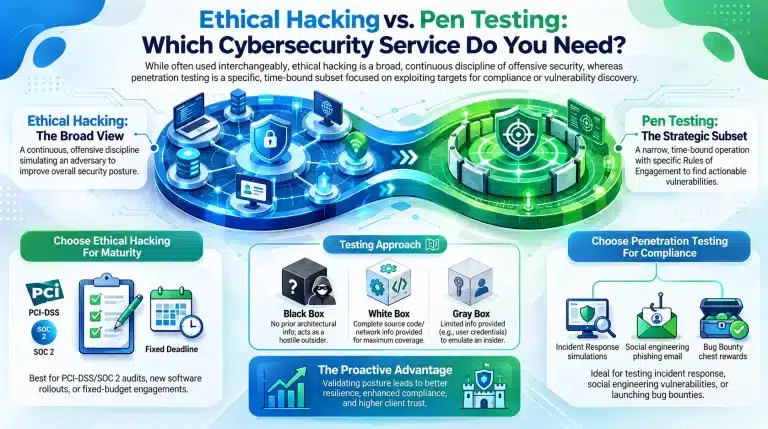
To put it simply, Ethical hacking is the broad, continuous discipline of using offensive techniques legally to improve overall security posture. Penetration testing is a narrow, time-bound subset of ethical hacking focused on exploiting specific target assets to satisfy compliance or find actionable vulnerabilities. Penetration testing is always ethical hacking; however, not all forms of ethical hacking constitute penetration testing.
What is Ethical Hacking?
Ethical hacking has a wide view of security. An ethical hacker assumes the role of an adversary resident in the organization and constantly poses the question, “How would an intruder hack this organization?”
The scope of work done by ethical hackers is very wide because they operate in different environments.
Common Attack Vectors in Ethical Hacking
Open-Source Intelligence (OSINT): Reconnaissance of company assets, personnel information, stolen credentials, and supply chain information.
Social Engineering: Conducting spear-phishing operations, making pretext calls or even conducting physical site attacks.
Red Teaming: Evading detection from EDR, pivoting across internal networks and SOC reaction time tests.
Research and Bug Bounties: Continuous hunt for new logical issues or Zero-Days at the company’s perimeter.
Ethical Hackers use attack chaining a lot, i.e., exploiting a small vulnerability in the social engineering vector combined with a small cloud misconfiguration to get sensitive business data.
What is Penetration Testing?
Penetration testing is an operation that is carried out strategically. It is not just done anywhere in the enterprise but has specific Rules of Engagement (RoE) provided to the penetration tester. Penetration testing is greatly used to meet compliance requirements such as PCI-DSS, SOC 2, HIPAA, and ISO 27001.
The 3 Common Pen Testing Approaches
Black Box Testing: The tester does not get any prior architectural information acting as a hostile outsider to the system.
White Box Testing: The tester gets complete information about source codes and network diagrams along with authentication details to maximize coverage in minimum time.
Gray Box Testing: The tester gets limited information (for example, standard user authentication details) emulating an insider attack scenario.
Ethical Hacking vs. Pen Testing: Which One Does Your Organization Need?
Understanding ethical hacking vs. pen testing comes down to evaluating your organization’s security maturity, risk appetite, and immediate compliance goals.
Choose a Penetration Test if:
You are preparing for an audit or certification for PCI-DSS, SOC 2. You have recently rolled out a significant new version of a website/application/api/infrastructure. You need a third-party verification report to present to your enterprise clients. You need an engagement that is well-bounded both financially and with respect to schedule.
Choose Ethical Hacking (or Red Teaming) if:
Your organization already conducts pen testing and has set up a baseline level of hygiene.
Your organization wishes to test the effectiveness of your incident response team at detecting and containing hidden attacks.
There is a need for assessment of non-technical methods of attack, such as social engineering and vendor security.
Your organization is looking to launch a Bug Bounty program.
Building a Proactive Security Strategy
The days of cybersecurity being about stopping every attack are gone. Cybersecurity today is about knowing how the attackers behave, finding vulnerabilities before exploitation, and constantly enhancing their defenses. The objective is always the same whether it is through the use of penetration testing or ethical hacking, or a combination of the two; to discover the risks before they become security incidents.
Organizations that take a proactive stance on validating their security posture have better resilience, enhanced compliance preparedness, higher client trust, and quick responses to threats.
Partner with IBN Technologies for Security Assessment Services
Beyond mere scanning technologies, organizations need to employ security professionals who can think like attackers, detect vulnerabilities and offer recommendations on how to deal with them.
When evaluating Ethical Hacking vs. Penetration Testing, we perform Vulnerability Assessment and Penetration Testing (VAPT), ethical hacking, web application security testing, API security testing, network penetration testing, and red teaming. We assist our clients in identifying potential gaps and strengthening their overall security posture.
If you require a pen test for the sake of meeting regulations or just need an overall ethical hacking project carried out, IBN Technologies will provide the necessary skills and security knowledge.
Need VAPT Services for your 2026 project?
Get a free consultation with our tech team — no commitment.
Frequently Asked Questions
Ethical hacking is a broader security practice that can involve various authorized offensive security techniques. Penetration testing is a specific type of ethical hacking focused on safely simulating attacks against defined targets to identify and validate security weaknesses.
No. Penetration testing provides a focused assessment of vulnerabilities within a defined scope, while a broader ethical hacking program can assess an organization's overall exposure across technological, behavioral, and physical security factors.
Organizations should generally conduct penetration testing at least annually, depending on their risk profile and applicable requirements. Additional testing may be appropriate after major system upgrades, new API releases, significant infrastructure changes, or other material changes to the environment.
The three common approaches are black-box testing, where the tester has little or no prior knowledge of the target; white-box testing, where the tester has extensive knowledge of the code and architecture; and gray-box testing, where the tester has partial knowledge of the target environment.