The contemporary enterprise is based on Software as a Service (SaaS). Everything from CRM solutions to HR tools, finance management systems to communication apps is now based in the cloud.
The rapid adoption of cloud technologies has led to an enormous problem for security experts – shadow IT, complex API integrations, and cloud misconfigurations.
As SaaS providers ensure the protection of the underlying cloud infrastructure, it’s up to you to protect the integrity of your data, user access permissions, custom integrations, and configuration options. Without vulnerability testing, your cloud apps will leak sensitive information about customers, finances, and intellectual property. VAPT must be used for cloud SaaS architecture to secure your cloud environment.
The Cloud Shared Responsibility Model: Where SaaS Security Breaks Down
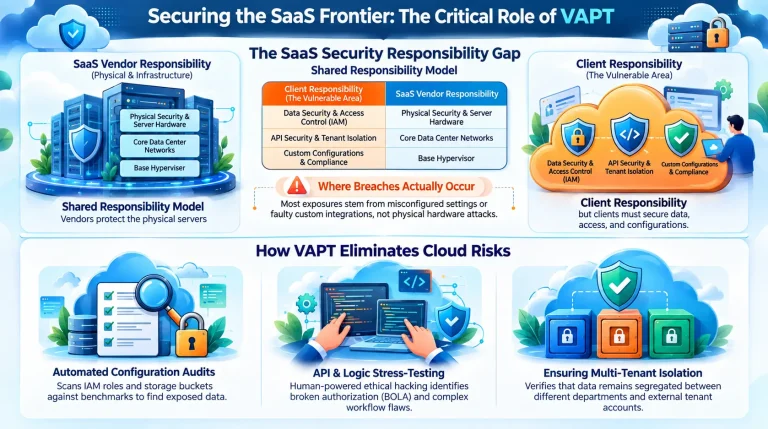
It is a misconception for the executives of many businesses to think that using a SaaS provider will ensure full security for their business. They forget about the cloud shared responsibility model:
| THE SAAS SECURITY DIVISION | |
| CLIENT RESPONSIBILITY
(Where Breaches Occur) |
Data Security, Access Control (IAM), APIs, Configurations, Tenant Isolation & Compliance |
| SaaS VENDOR
RESPONSIBILITY |
Physical Security, Server Hardware,
Core Data Center Networks, Base Hypervisor |
When sensitive data gets compromised in a SaaS application, it is never because the data center itself has been physically compromised by an attacker. This data exposure happens because of incorrect access privileges, exposed tenant API keys, or faulty custom integration software developed in-house—issues that are completely on the client.
5 Hidden SaaS Vulnerabilities That Expose Sensitive Data
Traditional vulnerability assessment tools may have difficulty assessing the vulnerabilities of cloud applications, since software-as-a-service applications depend on multi-tenancy, continuous deployment, and microservices.
A specialized SaaS VAPT program will reveal crucial cloud-related vulnerabilities:
- Broken Object-Level Authorization (BOLA)
IDOR or BOLA (Blind Object Level Authorization) continues to be the leading API vulnerability in cloud applications. This vulnerability is present when the application fails to authenticate the user’s access permissions to access the object in the database (such as /api/v1/invoices/1092). All that the attacker has to do is modify the ID in the API link.
- Multi-Tenant Isolation Failures
When a SaaS product is used, several customers use one cloud platform and databases at the same time. A vulnerability related to multi-tenancy enables an adversary who is in Tenant A to violate the application logic and gain access to, steal, or damage the private databases or files of Tenant B.
- Misconfigured Security Settings & Over-Privileged Access
Default setting in software-as-a-service systems, such as Salesforce, Microsoft 365, or Google Workspace, is normally designed for ease-of-use rather than security. Misconfigured sharing, non-existent MFA policies, and excessive privileges of service accounts can be leveraged to gain access to unauthorized data.
- Insecure Webhooks and Third-Party APIs
SaaS tools now use webhooks and REST/GraphQL APIs to share information. If the webhooks are not authenticated, or the token validation or rate-limiting is not implemented, then it can give cybercriminals access to data flows or even perform SQL injections.
- Session Hijacking and Flawed OAuth Flows
Single Sign-On that is vulnerable, and/or OAuth 2.0 that is implemented incorrectly allow attackers to take overactive user sessions, completely skip the authentication process and get access to cloud dashboards.
How SaaS VAPT Identifies and Eliminates Cloud Risks
A complete methodology for SaaS Vulnerability Assessment and Penetration Testing involves automation scanning and advanced human-powered ethical hacking of your cloud attack surface.
| VAPT Stage | Methodology | Practical Outcome |
| Cloud Configuration Audit | Automated review of IAM roles, storage buckets, and security settings against CIS Benchmarks | Identifies exposed S3 buckets, weak password policies, and excessive user permissions |
| API & Microservices Testing | Manual ethical hacking aligned with OWASP API Security Top 10 | Discovers BOLA flaws, rate-limiting bypasses, and unauthenticated endpoints |
| Multi-Tenancy & Authorization Checks | Privilege escalation tests across different user roles and tenant accounts | Ensures absolute data segregation between internal departments and external tenants |
| Business Logic Exploitation | Simulating real-world workflow manipulation and session hijacking | Catches complex flaws that automated scanners miss, such as checkout or transfer bypasses |
Secure Your SaaS Application Ecosystem with IBN Technologies
IBN Technologies assists businesses, SaaS vendors, and financial organizations in securing their cloud applications and digital assets through our dedicated SaaS and Cloud VAPT Services. We carry out comprehensive security vulnerability assessment and penetration testing of all your digital systems, including web applications and APIs, without affecting the business processes.
Our team of certified security professionals (OSCP, CEH, CISSP) is trusted and relied on by many organizations and combines the power of security automation tools and manual work for delivering precise and actionable results. We provide compliance reports, Safe-to-Host certificates, and other services required by organizations to be compliant with various industry standards like ISO 27001, SOC 2 Type II, PCI-DSS, HIPAA, GDPR, and DPDP.
Protect Your Cloud Data Before a Breach Occurs
Relying on default SaaS configurations is a highly risky move. An active and certified VAPT security assessment can guarantee that your cloud-based applications are always secure and compliant.
Contact IBN Technologies today to schedule a comprehensive SaaS VAPT security consultation with our cloud security specialists.
Need VAPT Services for your 2026 project?
Get a free consultation with our tech team — no commitment.
Frequently Asked Questions
Standard scanners may not identify logical vulnerabilities arising from multi-tenancy, continuous deployments, complex APIs, and application-specific business logic. Vulnerabilities such as authorization bypasses often require manual security testing and ethical hacking techniques to identify and validate.
Broken Object Level Authorization (BOLA) is an API security vulnerability that can allow unauthorized users to access another user's data by manipulating an object identifier in an API request, such as changing /invoices/101 to /invoices/102.
SaaS VAPT helps organizations identify and remediate security vulnerabilities while providing security assessment reports and supporting documentation that may contribute to compliance requirements under frameworks and regulations such as ISO 27001, SOC 2, PCI DSS, HIPAA, and GDPR.