Are you curious if vulnerability assessments actually enhance cybersecurity in 2026, or is it just another security assessment methodology which has become the norm? Due to the rapidly evolving threat landscape in today’s time, it is crucial for organizations to adopt to systematic vulnerability management to ensure their preparedness for any vulnerabilities.
In this article, you will learn about security vulnerability assessments in-depth, why it is more important now than ever before, and what measures are required for conducting these assessments successfully.
What Is Security Vulnerability Assessment?
Security vulnerability assessment refers to the methodical approach that is undertaken to find out, examine, and evaluate any weaknesses in the IT security system of an organization. It allows organizations to determine their security risks and address them to enhance their security position. The technique includes searching for vulnerabilities in the organization’s systems and evaluating their severity and implications. In summary, it allows determining which security vulnerabilities exist in the organization and how best to remedy them.
Is Security Vulnerability Assessment Still Relevant In 2026?
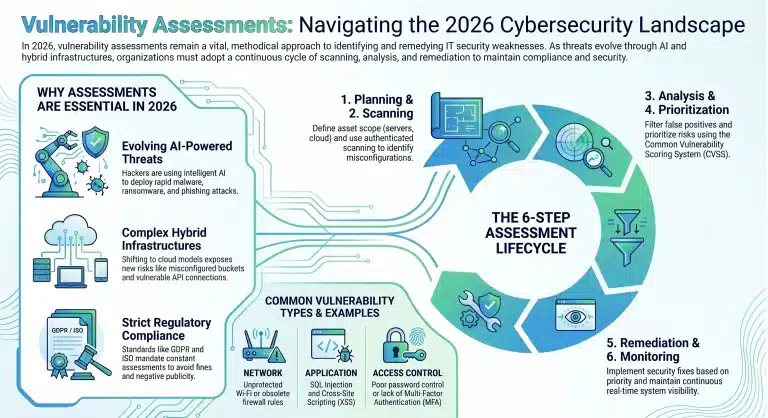
While moving through the intricacies of 2026, the response comes out to be an absolute yes for reasons stated below. The Security Vulnerability Assessment remains as important in the present age of cybersecurity as ever before.
The Emergence of Cyber Threats
The use of modern and highly intelligent malware and exploits through artificial intelligence by hackers is currently on the rise, with the threat posed to companies of all sizes by the malware, ransomware, and phishing attacks being extremely fast.
The Development of Cloud and Hybrid IT Infrastructure
Many organizations have shifted to cloud and hybrid models, exposing themselves to a wider range of attacks. It is vital for modern assessments to spot misconfigurations in cloud buckets and vulnerable API connections that exist within hybrid cloud architectures.
Rising Regulations and Compliances
Laws relating to data privacy have become increasingly strict. Standards like GDPR, ISO standards, and industry standards emphasize constant vulnerability assessments and reporting to ensure compliance with standards. This ensures that organizations avoid any possible fines and negative publicity.
Increased Risks from Remote and Distributed Employees
Remote working has created new security weaknesses, which necessitate robust endpoint protection and network security measures. The assessments will concentrate on endpoint security and security weaknesses that arise from remote access software and virtual private networks (VPNs).
Continuous Monitoring and Visibility
With the emergence of modern cybersecurity, real-time visibility of systems becomes an integral part. This is why a security vulnerability assessment becomes essential to ensure a continuous security state without exposing any newly added software or hardware components to potential threats.
How Is a Security Vulnerability Assessment Conducted?
A professional security vulnerability assessment is done through an organized approach to ensure that all the risks are accurately identified.
- STEP 1. Planning and Defining the Scope The first step in carrying out an assessment is to identify the key assets that could be either servers, mobile devices, or even cloud services. Defining the scope is very vital in the assessment process as it enables the assessment to focus on key elements.
- STEP 2. Scanning and Identifying Vulnerabilities
The security personnels make use of authentication scanning and non-authentication scanning techniques to determine the weaknesses within an environment such as security exploits, outdated patches, and misconfigurations.
- STEP 3. Analysis of Security Vulnerabilities The security weaknesses once identified undergo an analysis phase to determine whether they pose real threats or just false positives.
Common Types of Vulnerabilities Found During a security vulnerability assessment:
- Network Vulnerabilities: Issues such as unprotected Wi-Fi access point or obsolete firewall rule discovered through network security vulnerability assessment.
- Application Vulnerabilities: Vulnerabilities within the program, including SQL Injection and Cross-Site Scripting (XSS) are discovered through application vulnerability testing and assessment.
- Cloud Security Vulnerabilities: Incorrect permission configurations and incorrect settings for storage of information in public cloud are discovered through cloud vulnerability assessment.
- Access Control Vulnerabilities: Poorly implemented password control or non-existent Multi-Factor Authentication (MFA) are discovered through access control vulnerability assessment.
- STEP 4. Assessment and Risk Prioritization All risks have varying levels of importance. Prioritization of the risks is done according to the extent of damage it can cause and the possibility of exploitation, through a standardized system known as the Common Vulnerability Scoring System (CVSS).
- STEP 5. Security Fixes and Improvements In this stage, the implementation of security measures takes place. The security measures are implemented, improved, and fixed according to the priority list.
- STEP 6. Ongoing Assessment and Monitoring The cycle continues, and ongoing monitoring becomes part of the process.
How Can Businesses Enhance the Efficiency of Security Vulnerability Assessment?
For any security assessment program to achieve maximum efficiency, businesses should apply a systematic approach, as exemplified by the one below.
Regular Conduct of Assessments
Assessments should be conducted more than just annually. It should happen every month or even continuously, with the use of automation.
Use of Both Automated and Manual Testing Methods
Although automation makes it possible to conduct penetration testing on a larger scale, only humans can discover logical flaws in security systems, hence both are necessary.
Focusing on Key Business Assets
Key business assets like customer databases, intellectual property, and financial information should be considered first when conducting an assessment to minimize business risk.
Matching Assessment Needs with Compliance
Coordinate your scanning schedule and reporting standards to adhere to relevant standards, for example, GDPR, HIPAA, and PCI-DSS, to minimize potential legal risks.
Quick Implementation of Remedial Measures
Immediate implementation of remedial strategies is crucial to avoid any abuse of discovered vulnerabilities.
Final Thoughts
For organizations in 2026, the Security Vulnerability Assessment will continue to be an integral component for implementing successful cybersecurity measures. This is not only a technical process but also a vital requirement. Businesses need to develop client confidence by detecting vulnerabilities before they become a major issue. In the world of cybersecurity, such assessments give you an edge over the adversary.
At IBN Technologies, we provide expert cybersecurity services that can work through complex and ever-changing threat scenarios. Connect with us today to get started!
Frequently asked questions
Q1. Should organizations conduct vulnerability assessments on a regular basis? Yes, organizations are recommended to carry out the vulnerability assessment at regular intervals, mainly after system upgrades or infrastructure updates.
Q2. What is the distinction between vulnerability assessment and penetration testing? The vulnerability assessment involves identifying vulnerabilities, whereas penetration testing aims to test the ability to exploit those vulnerabilities.
Q3. Can I use the Security Vulnerability Assessment for my small business? Yes, security vulnerability assessments can be used for businesses of any scale.
Q4. Can vulnerability assessments offer continuous security? Yes, vulnerability assessments can provide continuous security if performed periodically along with security monitoring and management activities.