Enterprise cyber strategies typically share one critical flaw – the perception that security verification is a once-a-year check box. Although it may satisfy your auditors, a single penetration test on day 1 leaves your company completely exposed to the new cyber risks that emerge from day 2 through day 365.
For real cyber resiliency in today’s environment, businesses need to shift from individualized tests to a proactive approach to continuous enterprise security verification. This blog explains how you can create a cloud penetration testing strategy that will deliver value.
Moving Beyond the “Check-the-Box” Compliance Mentality
To many companies, penetration testing or “pen test” is merely a compliance requirement for PCI DSS, SOC 2, and HIPAA certifications. Compliance is important; however, making it your focus causes a huge gap in your operations because:
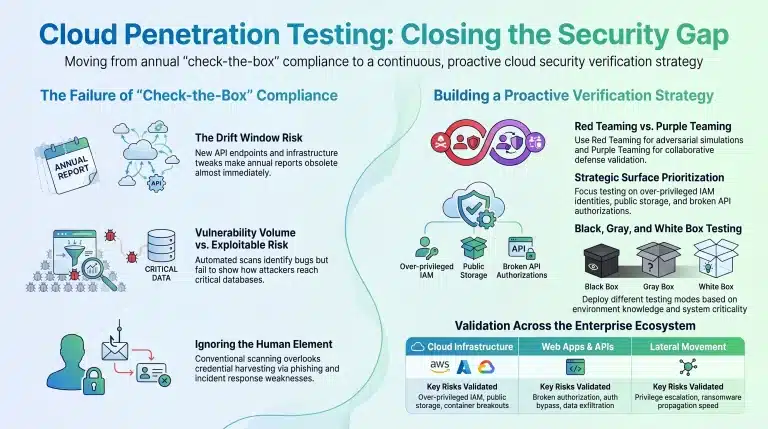
- The Drift Window: The moment a developer pushes a new API endpoint, or an infrastructure engineer tweaks an AWS Security Group, your annual report becomes obsolete.
- Vulnerability Volume vs. Exploitable Risk: Automated vulnerability assessments will dump a 400-page report of “High” and “Critical” alerts. They don’t tell you which flaw allows an attacker to pivot into your financial database.
- Ignoring the Human Element: Conventional scanning totally overlooks human factors like harvesting credentials via phishing or weaknesses in your incident response plan.
True security penetration testing isn’t about collecting a list of software bugs; it is about testing your detection, containment, and response capabilities under realistic stress conditions.
Advanced Testing Ecosystems: Red Teaming vs. Purple Teaming
When scaling an enterprise security program, selecting the right penetration testing methodology depends entirely on your organizational maturity. Modern verification has evolved into specialized team paradigms:
- Red Teaming (Adversarial Simulation)
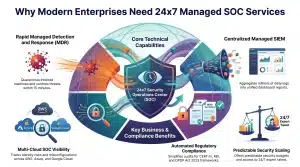
Unlike a standard network pen test, a Red Team engagement is objective-driven (e.g., “Infiltrate the HR payroll server”). The internal IT security team (the Blue Team) is intentionally kept in the dark. This tests not only the technical perimeters but also whether your security operations center (SOC) can detect and stop a stealthy adversary in real time.
- Purple Teaming (Collaborative Validation)
Purple Teaming is the advanced form of Enterprise Validation. This means that the attacking team (Red Team) and the defending team (Blue Team) are working together simultaneously. The Red Team uses various attack techniques such as SQL Injections (SQLi) and Cross-Site Scripting (XSS), while the Blue Team checks whether WAF or EDR detected their action.
Maximizing ROI with Cloud Penetration Testing
Enterprise spaces are too large for perfection in all tests. Your software needs to be well-focused on prioritizing attack surfaces using the best cloud penetration testing services:
| Testing Surface | Strategic Enterprise Focus | Key Risks Validated |
| Cloud Infrastructure | AWS, Azure, Google Cloud architectures. | Over-privileged IAM identities, public storage buckets, container breakouts. |
| Web Applications & APIs | Custom codebases, microservices, third-party integrations. | Broken object-level authorization, authentication bypass, data exfiltration. |
| Internal Lateral Movement | Corporate networks, Active Directory, endpoint devices. | Privilege escalation, NTLM relay attacks, ransomware propagation speed. |
Selecting the Right Approach: Black, Gray, or White Box
To balance time and budget, use different deployment testing modes in following manner:
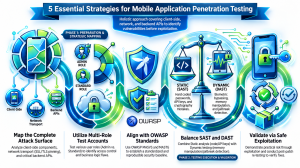
- Black-Box Testing is recommended for scenarios when there is no information about the environment at all in order to conduct tests of the organization’s periphery against unknown cyber attacks.
- Gray-Box Testing is appropriate to use when there is limited access for the users, which means that the hacker has gained access to a regular user account.
- White-Box Testing should be used for highly critical systems with zero tolerance for bugs in logic.
Secure Your Digital Future with IBN Technologies
True security isn’t a check-the-box compliance exercise, it is a continuous cycle of breaking, fixing, and hardening. By transitioning to a proactive security validation framework, your enterprise can pre-empt advanced threats, optimize its IT investments, and maintain ironclad resilience.
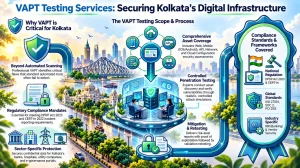
IBN Technologies delivers certified VAPT solutions with OSCP, CEH, and CISSP-certified experts who go beyond automation through advanced manual testing across multi-cloud, hybrid, and web environments ensuring zero disruption. We provide prioritized, compliance-ready insights (PCI DSS, SOC 2, HIPAA, ISO 27001) and support long-term security with developer guidance and validation scans for airtight protection.
Conclusion
Your digital assets are only as strong as your weakest unpatched gap. Don’t wait for a costly data breach to expose the hidden vulnerabilities in your perimeter. Partner with IBN Tech, the best cybersecurity service provider company, to prove your defenses work, appeasing your auditors, and safeguarding your business.
Contact US Today for a Free Expert VAPT Consultation
FAQs
- What is the difference between a vulnerability assessment and a penetration test?
Vulnerability Assessment automatically checks for known software defects in your network. The penetration test takes it up a notch as the security expert will try to exploit these vulnerabilities to assess how much a real attacker can get into your corporate environment.
- How often should an enterprise conduct cloud penetration testing?
Although regulatory frameworks such as PCI-DSS and SOC 2 require testing once per year, high growth enterprise setups must conduct tests every quarter or after any infrastructure upgrades, code release or cloud AWS/Azure configuration changes.
- Will a penetration test cause any operational downtime or business disruption?
Absolutely not. A reputable security services firm will have structured rules of engagement when doing the testing and it is always possible to do testing at off-peak times or within a cloned/staging environment without causing any disruption at all.