Your network is not only connecting your systems but also connecting the risks. While your application might be secured, your APIs have been tested and your cloud environment assessed, what about your network that ties everything together? Firewalls, routers, switches, virtual private network gateways, and wireless access points make the very fabric of your infrastructure, and any flaw in them will give rise to potential threats.
Network VAPT (Vulnerability Assessment and Penetration Testing) evaluates the security of your network by identifying vulnerabilities and actively testing how attackers could exploit them.
What Is Network VAPT?
As cyberattacks become increasingly common on network infrastructures, there is need for something more than basic security audits to maintain protection. Network VAPT is a security evaluation that helps to identify vulnerabilities within networks, and how well the current security measures can withstand attacks.
From firewalls and routers to VPNs and internal network segments, Network VAPT helps uncover misconfigurations, insecure services, and access control issues that could allow attackers to gain a position or move laterally within the environment. The result is a clear understanding of network security risks and practical suggestions for remediation.
Network VAPT Testing Areas
VAPT (Network) involves assessing the vulnerabilities in the network of an organization. The assessment of the network will typically consider the following three categories:
External Network VAPT
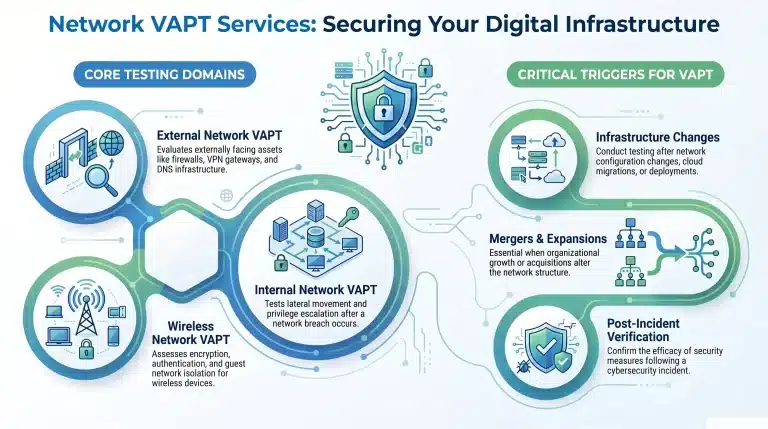
External Network VAPT is the testing of externally facing network assets from the perspective of an attacker. It evaluates the firewall, Virtual Private Network (VPN) gateway, remote access services, Domain Name System (DNS) infrastructure, and externally available hosts for vulnerabilities and misconfigurations.
Internal Network VAPT
The Internal Network VAPT scenario tests how an attacker behaves after gaining access to the network using compromised credentials, phishing, or other insider threats. The assessment covers network segmentation, Active Directory security, privilege escalation, lateral movements, and internal system security and management interfaces.
Wireless Network VAPT
VAPT for Wireless Networks includes evaluation of the security associated with wireless networks, access points, and wireless devices. It covers wireless encryption, wireless authentication methods, wireless access point configuration, guest network isolation, and wireless vulnerabilities that can be exploited by malicious actors.
By testing these three crucial components, Network VAPT helps companies discover weak spots that can lead to breaches of security.
When to Conduct Network VAPT
Network VAPT should be conducted whenever there are changes in your IT infrastructure or validating the current security measures.
- As part of the periodic assessment of an organization’s IT security, aimed at discovering any vulnerabilities and maintaining good security standards.
- After carrying out any changes or improvements on an organization’s infrastructure and network configuration.
- When entering into a cloud or hybrid environment for ensuring proper security measures are in place.
- If an organization undergoes merger, acquisition or expansion processes that result in changes to the network structure.
- After deploying new security solutions to ensure their correct implementation and efficacy.
- After cybersecurity incidents to discover the cause and confirm the efficacy of remediation measures taken.
- Before allowing access to external parties in order to protect internal sensitive systems.
Regular Network VAPT ensures that organizations can keep up with the changing threat landscape while maintaining security in their networks.
Need VAPT Services for your 2026 project?
Get a free consultation with our tech team — no commitment.
How IBN Technologies Delivers Network VAPT
At IBN Technologies, our approach to Network Vulnerability Assessment and Penetration Testing (VAPT) is based on risk, allowing us to help companies discover, verify, and fix the vulnerabilities in their network infrastructure.
Our analysis goes beyond scanning because we use an analysis conducted by experienced security specialists who carry out penetration tests.
The network assessment includes analyzing external, internal, and wireless networks, including firewalls, virtual private networks, network segmentation, access control, Active Directory, and systems exposed to the internet. Using our security specialists, we can simulate possible attacks to test vulnerabilities that you may have and determine the potential effect of the identified weaknesses.
After the assessment, you will receive a detailed report that includes findings of the analysis, proof of concept, and recommendations to eliminate the issues.
Frequently Asked Questions
The top findings for Network VAPT include the following: network segmentation problems, availability of administrative services, firewall configuration problems, insecure protocols, privilege escalation, and weak authentication controls.
It depends on the environment in which the assessment needs to be carried out. The Network VAPT test can be completed in 2–3 weeks.
Some of the major compliance programs that recommend Network VAPT include PCI DSS, ISO 27001, SOC 2, HIPAA, MAS TRM, and RBI Cyber Security guidelines.
It tests all internet-facing assets to see if an external attacker can breach your perimeter. Scope includes public IP ranges, firewall rules, VPN gateways, DNS security, SSL/TLS setups, and email protocols (SPF/DKIM/DMARC).