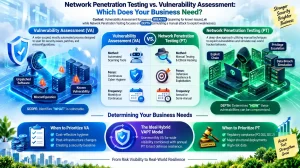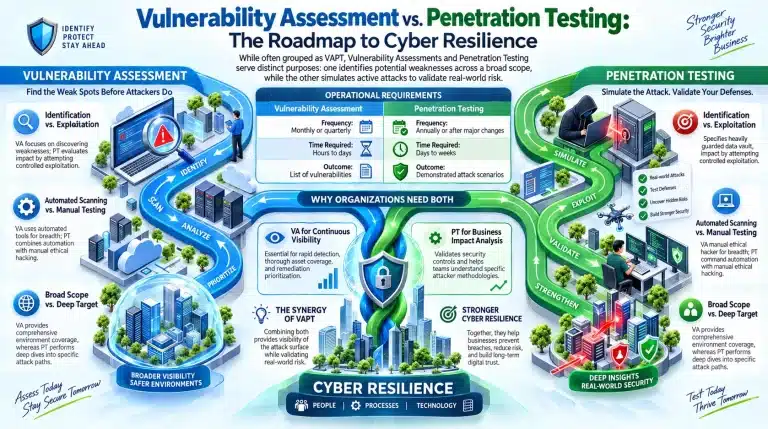
Cybersecurity attacks have become more sophisticated, so security testing should be done in advance for any organization. When evaluating Vulnerability Assessment (VA) vs. Penetration Testing (PT), it is clear these are the most popular types of security testing. While often grouped into one type of assessment called VAPT (Vulnerability Assessment and Penetration Testing), these approaches have different goals.
It is essential to understand Vulnerability Assessment vs. Penetration Testing to make an informed choice and to use your money properly.
What Is a Vulnerability Assessment?
A vulnerability assessment is a security testing process that identifies and prioritizes vulnerabilities across an organization’s IT environment. It helps security teams discover potential weaknesses in networks, applications, systems, and cloud infrastructure before they can be exploited by attackers.
Learn more: Read our detailed guide on What Is a Vulnerability Assessment?
What Is Penetration Testing?
Penetration testing, also known as ethical hacking, is a security assessment that simulates real-world cyberattacks to determine whether identified vulnerabilities can be exploited. Unlike a vulnerability assessment, which focuses on discovering weaknesses, penetration testing evaluates their actual impact by attempting controlled exploitation.
It helps organizations answer a critical question: “Can an attacker exploit these vulnerabilities, and what damage could they cause?” By combining automated tools with manual testing techniques, security professionals uncover attack paths, validate security controls, and assess the overall risk to critical systems and data.
Vulnerability Assessment vs. Penetration Testing: Key Differences
Though both types of security assessments target improving the cybersecurity situation, there are major differences between them.
| Factor | Vulnerability Assessment | Penetration Testing |
| Objective | Identify vulnerabilities | Exploit vulnerabilities and validate risk |
| Approach | Automated scanning | Manual and automated testing |
| Scope | Broad and comprehensive | Deep and targeted |
| Exploitation | No exploitation performed | Active exploitation attempted |
| Frequency | Monthly or quarterly | Annually or after major changes |
| Cost | Lower | Higher |
| Time Required | Hours to days | Days to weeks |
| Outcome | List of vulnerabilities | Demonstrated attack scenarios |
| Best For | Continuous vulnerability management | Security validation and risk analysis |
This distinction is often summarized as: In a vulnerability assessment, you identify the vulnerabilities; whereas in a penetration test, you demonstrate how an attack can be carried out using them.
When Should You Conduct a Vulnerability Assessment?
It is imperative that an organization conduct a vulnerability assessment anytime there is a need to have a complete picture of its risks. Be it through conducting security reviews regularly, complying with regulatory guidelines, patch management, secure networks within the organization, or even the cloud environment, there will always be some benefits to conducting vulnerability assessments. Through incorporating the practice into vulnerability management strategies, organizations will always stay ahead of potential threats.
When Should You Conduct Penetration Testing?
Whereas vulnerability assessments provide possible security vulnerabilities that exist within an infrastructure, penetration testing is concerned with verifying whether the vulnerabilities identified can be used to exploit the system by the intruders. Penetration testing is normally carried out by organizations prior to the introduction of a new application, following system or network upgrades, during the regulatory audits, and after workload migration to the cloud environment. It is also usually carried out prior to mergers and acquisitions of other companies to gauge inherited security vulnerabilities.
Why Vulnerability Assessments Alone Are Not Enough
Most companies utilize vulnerability scanners to detect security vulnerabilities within their systems, but automated scanners fail to understand if these vulnerabilities can be exploited by the attacker. For instance, security vulnerabilities like exposed services, poor user permissions, and lack of security patches may appear insignificant when considered individually. But through penetration testing, we get a clear idea about how an attacker can exploit them collectively to compromise the system.
Why Modern Organizations Need Both
The more advanced cybersecurity strategies neither opt for a choice between vulnerability assessment and penetration testing. Rather, they employ both as security methodologies.
Vulnerability Assessment Helps in:
- Keeping visibility of vulnerabilities
- Having a thorough asset coverage
- More rapid detection of vulnerabilities
- Better remediation prioritization
Penetration Testing Helps in:
- Conducting real attacks on the network
- Analysing the business impact
- Testing security controls
- Understanding attacker’s methodology
The combination of both methodologies enables to have visibility of the attack surface while validating that vulnerabilities represent business risks.
Common Misconceptions About VA and PT
Myth 1: Vulnerability Assessments and Penetration Tests Are The Same
Though they both deal with identifying vulnerabilities, the main difference is that vulnerability assessments are concerned with detection while penetration tests involve exploitation.
Myth 2: Penetration Testing Is A Substitute for Vulnerability Scans
A penetration test is only conducted once, and it cannot offer the same constant monitoring capabilities as vulnerability scans.
Myth 3: Vulnerability Scanners Identify Everything
Some business logic vulnerabilities and unique attack methods can be spotted only by penetration testers and not automated scanners.
Final Thoughts
Organizations that conduct vulnerability assessments on a consistent basis coupled with pen tests are more likely to be able to recognize and address any risk areas. The combination of both is what will allow businesses to achieve the needed visibility and verification for maintaining a healthy cybersecurity profile. At IBN Technologies, our cybersecurity experts deliver customized VAPT services to help organizations uncover vulnerabilities, assess real-world attack scenarios, ensure compliance, and strengthen their overall security resilience.
Need VAPT Services for your 2026 project?
Get a free consultation with our tech team — no commitment.
Frequently Asked Questions
No, it is not. As a rule, penetration tests are annual or post-update actions for systems only. Therefore, penetration testing cannot replace vulnerability assessments because vulnerability assessments are performed on a regular basis.
Vulnerability assessment should be performed on a continual, weekly, or monthly basis, depending on the organization’s risk profile and environment. Penetration testing should generally be conducted once or twice per year.
Both together form a comprehensive security program because vulnerability assessment provides visibility into the broader attack surface, while penetration testing evaluates the effectiveness of your defenses under realistic attack conditions.