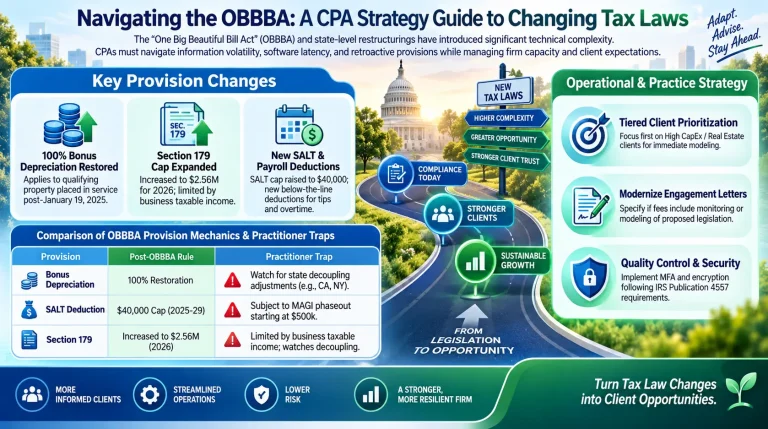
The American tax environment is at present undergoing a phase of considerable structural change. The passing of landmark tax legislation such as the “One Big Beautiful Bill Act” (OBBBA), coupled with tax code restructurings in states, presents the business environment with considerable complexity.
Some of the key changes in the federal tax code such as the reinstatement of 100 percent bonus depreciation, new limits on section 179, new SALT deduction limits, and carve-out deductions including those for overtime and tips necessitate continuous communications, on Tax laws and technical modeling with clients. On the other hand, the conventional operational systems remain challenged due to the lack of accountants and tight filing periods.
Why Tax Laws Create New Risk & Capacity Pressures for CPAs
Changing tax laws create direct technical and operational friction points for accounting firms:
- Information & Guidance Volatility: CPAs must monitor legislation, IRS notices, revenue procedures, tax forms, e-filing formats, court rulings, and state conformity at once.
- Unclear Implementation & Software Latency: Newly enacted laws may depend on Treasury regulations or instructions from the IRS before taxpayers can properly implement them. Tax software vendors generally wait to update modules until late in the filing season.
- Retroactive Provisions: Some of the legislative changes have retroactive effect on previously finished tax periods and necessitate balancing the process of amending returns with the core tax season activities.
- Divergent Client Impacts: The same tax legislation can provide instant deductions to one business entity while causing problems of documentation or withholding requirements for the other.
- State & Local Non-Conformity: The tax laws at the federal level do not result in conformity at the state level. Differences in depreciation periods, SALT and PTET cause double entry reporting issues.
- Circular 230 Standards & Liability Pressure: As per § 10.37 under Circular 230, any written opinion on tax issues should be based on factual accuracy and reasonable legal assumptions. Even in the absence of any pronouncement by the Treasury, clients require clear opinions.
Operational risk management should not just be about monitoring the official bulletins but should have an internal system for interpreting, modeling, and implementing compliance updates.
What Tax Law Changes Should CPAs Know?
Compliance after OBBBA will involve differentiating between overlapping provisions, statutory restrictions, and state conformity problems.
| Provision | Post-OBBBA Rule | Technical Mechanics & Practitioner Traps |
| 100% Bonus Depreciation | Restored for qualifying property placed in service post-Jan 19, 2025. | Mandatory by asset class unless an explicit election out is filed under Sec. 168(k). Unlike Sec. 179, bonus depreciation creates or increases Net Operating Losses (NOLs). Watch out for state decoupling adjustments (e.g., CA, NY). |
| Section 179 Expensing | Cap expanded to $2.56M with a $4.09M phaseout threshold for 2026. | Capped by business taxable income (cannot create an NOL). Crucial for qualified real property improvements (HVAC, roofs, fire protection) that do not qualify for bonus depreciation. |
| SALT Deduction Cap | Temporarily increased to $40,000 (2025–2029). | Subject to MAGI phaseout starting at $500k. In high-tax states, electing into state Pass-Through Entity Tax (PTET) regimes often remains superior to the raised federal cap for business owners. |
| Tips & Overtime Deductions | Below-the-line deduction ($25k tips / $12.5k–$25k overtime). | Requires precise payroll isolation and separate reporting on Form W-2 / 1099 via Schedule 1-A. Severe exposure to audit risk if documentation fails to prove “qualified” overtime definitions. |
Which Clients Face Tax Impacts?
Prioritize clients by tax impact to focus on the most urgent planning and compliance needs first.
- Tier 1: High CapEx & Real Estate Clients
- Focus: Immediate modeling of Section 179 versus bonus depreciation.
- Action: Consider asset class elections outside of bonus depreciation so that there won’t be any trapped state NOLs in jurisdictions that decouple from Section 168(k).
- Tier 2: Business Owners & Pass-Through Entities (S-Corps, Partnerships)
- Focus: Optimization for PTETs against the new $40,000 SALT cap.
- Action: Prepare dual scenario analyses to determine partner MAGI phase-outs vs. business deductions.
- Tier 3: Individual & Payroll-Impacted Clients
- Focus: Qualified overtime and tip deduction compliance.
- Action: Use automated client intake forms for gathering the required W-2 information prior to the start of the tax period.
Firm Technology, Security, and Quality Control
Technology is key to the implementation of these workflows. Contemporary practice management software automatically tracks clients, highlights impacted taxpayer profiles, and delegates technical activities to dedicated staff. Nonetheless, the business must form a quality control team within its structure for testing the tax software update on IRS notices before batching returns.
In addition, it is crucial to provide high-level cybersecurity, which means MFA, encryption of all portals, secure file transfers, and secure offsite backups in accordance with the requirements of IRS Publication 4557.
Practice Management: Scope Protection & Advisory Monetization
Tax law volatility creates an ideal opportunity to modernize your firm’s business model:
- Update Engagement Letter Scoping: It is essential to clearly specify in the annual engagement agreements whether the fees will include the work involved in monitoring proposed tax legislation or modeling the tax laws that are passed.
- Transition to Value-Based Billing: Transition clients who have been impacted by intricate legislative reforms from a fixed fee service for tax preparation to an ongoing quarterly tax planning service (such as mid-year scenario analysis, Sec. 174 expenses, entity restructure).
- Establish a Tax-Law Change Log: Create an internal change log that centralizes all information relating to changes in legislation, staffing, workflow, software implementations, and client notifications.
Final Thoughts
The monitoring of tax laws must always be a process that needs to be ongoing and systematic for a modern company. This will be achieved by ensuring technical precision, such as ensuring the proper balance between Section 179 and Bonus Depreciation, as well as managing PTET dynamics together with varying client demographics and engagements.
To achieve this, IBN Technologies offer tax return preparation, individual and business tax filing services, and tax season processing services.
Want to explore how to restructure engagement letters for tax law changes?
Frequently Asked Questions
CPAs must consistently monitor developments by the IRS, state taxing authorities, professional tax literature, and databases to remain current regarding the latest tax regulations.
Proposed tax laws are under review and may be changed prior to enactment; enacted tax laws have already been approved and therefore have legal validity and applicability.
CPAs need to analyze their client’s financial situation and tax liabilities based on the provisions of the new law.