As the complexity of digital infrastructure increases, it becomes necessary to go past basic firewalls and reactive approaches in ensuring a robust security stance. Many companies conduct audits on their network; however, there is a lot of confusion when it comes to two basic methods: Vulnerability Assessment (VA) and Network Penetration Testing (PT).
Though the two methods are often used synonymously or combined as one called VAPT, they have totally different purposes, different approaches, and even respond to different questions.
It is crucial to know which service is needed by your company and how you can use both services to achieve maximum results.
Understanding the Core Difference: Vulnerability Assessment (VA) and Network Penetration Testing (PT)
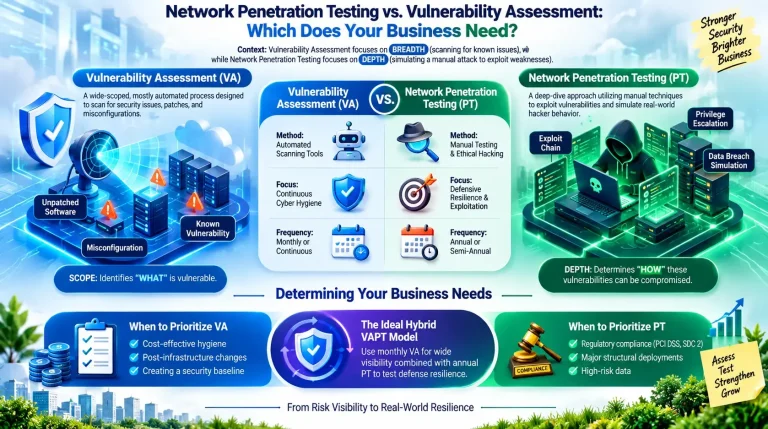
The basic distinction between Vulnerability Assessment and Network Penetration Testing is in the scope vs. depth approach.
Vulnerability Assessment: A mostly automated and wide-scoped evaluation process designed to scan network components (routers, servers, switches, end-point devices) for any security issues, patches and updates, configuration problems, and outdated protocols.
Network Penetration Testing: An approach aimed at exploiting the vulnerabilities detected using advanced manual testing techniques that are close to those used by hackers in the wild.
How Network Penetration Testing Works
The Vulnerability Assessment depends upon the use of special software applications working alongside the latest feeds of Global Threat Intelligence.
When Your Business Needs a Vulnerability Assessment
- Maintaining Continuous Hygiene: You require continuous visibility into any emerging CVEs, systems not patched, and system configuration drift within your network.
- Post-Infrastructure Changes: You have made additions of new servers, moved subnets to the cloud, or made system configuration changes and require to confirm the security baseline.
- Budget & Scope Constraints: You have an extensive network footprint to cover and require efficient monitoring of all devices.
Key Advantage: Quick, highly scalable, and provides actionable information instantly.
How Network Penetration Testing (PT) works
Penetration testing is not only about using automatic scanning tools. Ethical hackers utilize different techniques of reconnaissance, custom scripts for exploitation, techniques for chaining (combining several low-risk problems into one very high-risk path), as well as manual techniques for privilege escalation to determine how strong your defense mechanisms (e.g., Firewalls, IDS/IPS, EDR, etc.) will perform.
When Your Business Needs a Network Penetration Test
- Evaluating Defensive Resilience: You wish to check whether your SOC team and monitoring systems can effectively detect, alert on, and react to a current hacking attempt.
- Regulatory & Audit Compliance: You have to meet mandatory testing obligations related to PCI DSS, SOC 2, ISO 27001, CERT-In, HIPAA, SEBI, or GDPR.
- Major Structural Deployments: You are rolling out major structural changes such as introducing new infrastructure, connecting third-party networks, or deploying dangerous web applications.
- Third-Party Risk & Stakeholder Trust: Enterprise customers or insurers demand that your network security system passes the test of attack simulation.
What Does Your Business Actually Need?
Choosing between a Vulnerability Assessment and a Penetration Test is not an “either/or” decision it depends on your security maturity, business model, and operational goals.
Vulnerability Assessment is Right For You When:
- If you do not have automated asset discovery or patch management programs yet.
- If you require constant, cost-effective scans to keep your cyber hygiene up.
- If you’re creating a security baseline before proceeding with further security testing.
Penetration Testing Is Needed When…
- If you already regularly run vulnerability assessments and patch CVEs on time.
- If you work with very sensitive information (such as financial, healthcare or PII) or enterprise customers.
- If you’re going through a compliance audit soon.
The Ideal Hybrid Model (Integrated VAPT)
To implement an effective VAPT solution for cybersecurity defense, top companies follow a combination of both approaches:
- Continuous/ Monthly Vulnerability Assessment to detect any unpatched software, misconfigurations, or recently released exploits on their entire network infrastructure.
- Annual/Semi-annual Penetration Testing to put their network infrastructures under test.
Strengthen Your Security Posture with IBN Technologies
IBN Technologies provides custom VAPT services that are customized according to the complexities of your infrastructure and compliance needs. Our team of certified ethical hackers conducts assessments based on internationally acknowledged frameworks like OWASP, NIST, and ISO framework, offering you remediation support to ensure security of your critical assets.
From vulnerability management to network penetration testing, our team assists you in identifying the threats and vulnerabilities in your system.
Ready to evaluate your network defenses? Contact our cybersecurity experts at IBN Technologies today to schedule a comprehensive assessment.
Need Network Penetration Testing for your 2026 project?
Get a free consultation with our tech team — no commitment.
Frequently Asked Questions
A Vulnerability Assessment is the process of recognizing and identifying any known vulnerabilities within the organization’s entire network by using automated tools. Penetration Testing involves taking steps to exploit these vulnerabilities to understand the depth of an attacker’s access.
Vulnerability Assessment needs to be done either on a continuous basis or once a month to detect software vulnerabilities and misconfigurations. Network Penetration Testing must be performed at least once a year, every six months, or right after significant infrastructure modifications.
No. Ethical hackers conducting a penetration test make sure that the penetration test doesn’t have any negative impact on the ongoing business operations.
Several major compliance standards like PCI DSS, SOC 2, ISO 27001, CERT-In, HIPAA, SEBI, GDPR, among others mandate Penetration Testing.