The data breach cases on Indian healthtech platforms, hospital management software, and diagnostic platforms have been growing very rapidly. In light of the demand for medical records being high in the dark web, securing the patient’s data is no longer an optional aspect but a mandatory one for making sales in hospitals.
In view of the implementation of the Digital Personal Data Protection (DPDP) Act, 2023 and directives of CERT-In & NHA under ABDM, simple security controls will no longer suffice. You require proactive VAPT (Vulnerability Assessment and Penetration Testing) services to secure your platform.
Here are the 7 most important VAPT services and security measures required to secure your healthcare applications, guarantee regulatory compliance, and win enterprise clients in India.
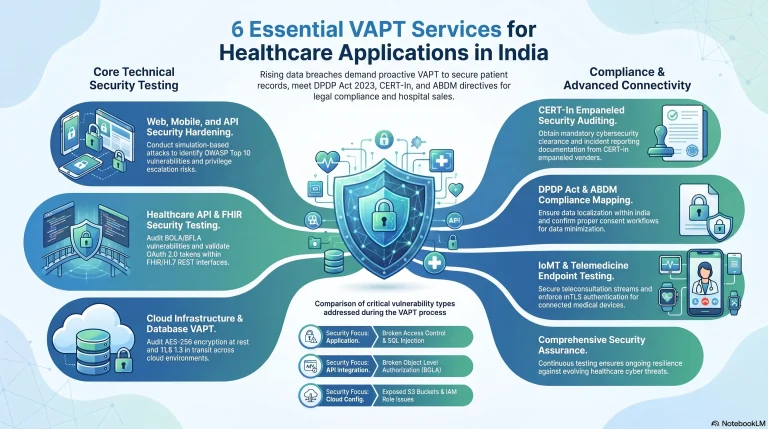
1. Web and Mobile Healthcare Application Penetration Testing
Healthcare portals deal with critical clinical workflows through web portals, Android, and iOS applications. VAPT services perform simulation-based cyber-attacks to discover any security vulnerabilities in the applications before any malicious user identifies them.
- OWASP Top 10 Coverage: Identify critical vulnerabilities, such as SQL injection (SQLi), XSS attacks, and broken access control.
- Privilege Escalation Checks: Ensure that users with lower levels of privilege, like patients and billing staff members, do not have access to the EHR through privilege escalation.
- Mobile App Security Hardening: Check security in terms of encryption of local data, code obfuscation, and biometrics in mobile applications.
Healthcare API & FHIR Security Testing
The HealthTech ecosystem integrates numerous APIs to connect with labs, pharmacies, and telemedicine applications. These interfaces present the largest avenues for attacks in the digital health environment.
- BOLA & BFLA Vulnerability Assessment: Identify and test the API vulnerabilities such as Broken Object Level Authorization (BOLA) and Broken Function Level Authorization within the FHIR/HL7 REST APIs.
- OAuth 2.0 & Token Validation: Conduct audits for authentications and session management in third-party integrations.
- Payload Injection Mitigation: Validate all JSON/XML payloads obtained from API gateways.
2. CERT-In Empaneled Security Auditing & Certification
HealthTech organizations in India must ensure that their organization’s cybersecurity clearance is done by the government.
- Mandatory Compliance Clearance: Work with the vendors who offer vulnerability assessment services certified by CERT-In.
- Audit Documentation: Ensure that you have complete vulnerability assessment reports and cybersecurity clearance certificates as per enterprise hospital guidelines.
- CERT-In Incident Reporting: Ensure that your application monitoring architecture is compliant with CERT-In guidelines on cyber incidents.
3. DevSecOps& Automated Vulnerability Scanning
Security testing shouldn’t be seen as an activity that is conducted once before deployment. Incorporating VAPT as part of your CI/CD application will help you get continuous application security.
- Automated SAST & DAST: Conduct Static Application Security Testing at the time of committing the code and Dynamic Application Security Testing in the staging environment.
- Software Composition Analysis (SCA): Conducting the software composition analysis of third-party open-source components for vulnerabilities in your SBOM.
4. Cloud Infrastructure & Database VAPT Services
Application security is as strong as its underlying cloud environment. Penetration testing of the cloud environment in question – whether it’s AWS, Azure, or GCP regions in India needs to be done to secure the application in healthcare.
- Cloud Misconfiguration Audits: Determine whether there are any exposed S3 buckets, excessive security group permissions, and issues in the configuration of IAM roles working with the patient database.
- Encryption Verification: Audit AES-256 encryption at rest for database volumes and TLS 1.3 in transit across all server endpoints.
- Database Hardening: Perform pen tests on database instances holding health metric data.
5. IoMT & Telemedicine Endpoint Penetration Testing
Medical digital platforms are now beginning to integrate more with IoMT hardware, monitoring equipment, and teleconsultation channels.
- mTLS Authentication Testing: mTLS should be enforced to ensure that authentication takes place for both the IoMT device and the server before the telemetry data is sent.
- Firmware & Hardware Audits: Perform pen-tests on connected devices and telemetry traffic to prevent any form of data manipulation.
- Teleconsultation Stream Security: Test the WebRTC and video stream protocol for any form of session hijacking.
6. DPDP Act & ABDM Security & Compliance Mapping
A strong VAPT process is not just about fixing code problems; it confirms that your software control processes conform to India’s stringent data privacy regulations.
- DPDP Act Consent Workflows: Confirm proper workflow for managing consents, data minimization processes, and the “Right to Erasure.
- ABDM/ABHA Interoperability: Safe HIECM API integrations that comply with the National Health Authority.
- Data Localization Compliance: Sensitive patient health information should be hosted within the geography of India.
Secure Your Healthcare Application with Enterprise VAPT Services
Handling security regulations while offering software features is something that needs to be done by people who are deeply versed in the healthcare domain. Ignoring any security loopholes can stop sales processes in hospitals and incur heavy penalties on account of DPDP Act.
IBN Technologies Specialized Healthcare VAPT & Cybersecurity Team Can Help You:
- Perform comprehensive VAPT Services for web, mobile, and API healthcare platforms.
- Secure official cybersecurity certification for hospital procurement.
- Achieve complete DPDP Act & ABDM compliance readiness.
- Protect FHIR APIs and cloud infrastructure against ransomware and cyber threats.
Let’s talk security. Schedule a free 30-minute VAPT consultation and learn how to better protect your healthcare systems and patient data.
Need VAPT Services for your 2026 project?
Get a free consultation with our tech team — no commitment.