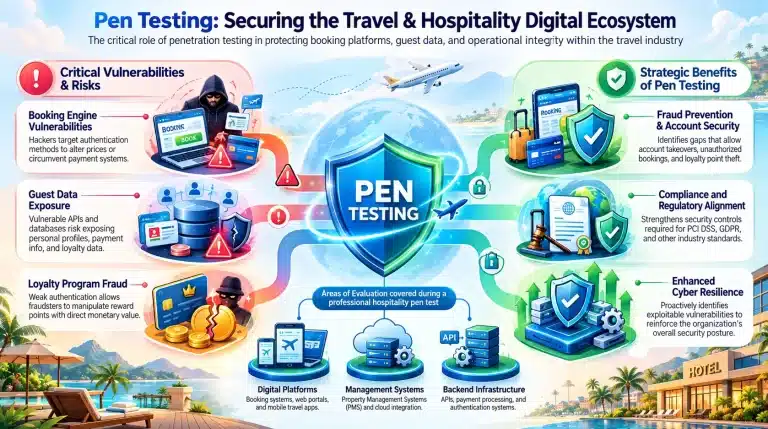
Every day, the travel and hospitality sector handles millions of sensitive transactions, which makes it a lucrative target for attackers. The attack surface is very extensive due to many elements including direct booking engines, GDS, PMS at the front desk, smart key card locks, and others. It is therefore very important to carry out Pen Testing for travel and hospitality.
Why Travel & Hospitality Businesses Need Penetration Testing
A contemporary hospitality system involves interconnected systems including reservation systems, payment systems, loyalty systems, mobile applications, guest Wi-Fi systems, and travel partner integration systems. In the opinion of industry guidelines, such systems present a broad attack surface wherein any one single weakness can lead to the exposure of several thousand customer records or business interruptions.
If the penetration tests are not performed at regular intervals, the organization may never know about such critical weaknesses that might result in data thefts, access control breaches, or booking frauds.
Key Risks Facing Booking Platforms and Guest Data
Booking Engine Vulnerabilities
Online booking systems are one of the major sources of income for hotels, resorts, travel agents, and tourism-related businesses. Hackers tend to attack booking systems to take advantage of their authentication methods, alter prices, circumvent payment systems, or even gain access to customers’ accounts. Booking engine vulnerabilities are one of the key threats discovered through security evaluations in the industry.
Guest Data Exposure
Sensitive guest data is collected and stored by the travel platforms at various stages of the booking process. It comprises personal profile data, scheduling data, payment information, identification information, and loyalty data. When insecure, this sensitive data becomes accessible through web applications, database security breaches, and API security vulnerabilities. Guest data protection is recognized as one of the major cybersecurity challenges in hospitality.
Loyalty Program Fraud
The value of loyalty accounts is based on the points or the rewards stored in these programs, which have direct monetary value. Thus, loyalty accounts become prime targets of hacking. Any weakness in the authentication process or the business logic used by such programs allows fraudsters to move points around and takeover accounts.
API Security Risks
The travel and hospitality industry depends on APIs to link booking engines, travel partners, payments providers, and mobile apps. Lack of proper authorizations or insecure configurations of APIs can make reservations information and customer information vulnerable. Security references specific to hospitality mention API testing as one of the most important elements of securing guest-facing platforms.
What Does Pen Testing for Travel & Hospitality Cover?
A Travel & Hospitality Pen Testing process covers the whole range of digital environments to find any possible vulnerabilities that may cause any security issues.
Areas of evaluation include:
- Booking systems and reservation services
- Guest accounts and web portals
- Mobile applications for travel management
- Loyalty schemes and reward services
- Web applications and APIs
- Property Management Systems (PMS)
- Payment processing systems
- Cloud computing and cloud integration
- Authentication and access control systems
By running attack scenarios on the vulnerabilities found, pen testers verify whether they can be exploited and measure their business impacts.
Benefits of Pen Testing for Hospitality Organizations
Pen Testing for Travel & Hospitality is vital to maintain both safety and competitive benefits.
- Protecting Guest Information: Identifies vulnerabilities that can result in exposure of customer’s personal information.
- Online Booking Platform Safety: Keeps the company safe from any cyber-attacks on the organization’s booking and payment platform.
- Decrease Frauds: Finds security gaps allowing for the takeovers of the accounts, making unauthorized bookings or taking loyalty points.
- Compliance Needs: Allows organizations to improve the security controls required for compliance with PCI DSS, GDPR and others.
- Customer Loyalty: Customer Loyalty: Demonstrates the security and privacy assurance for the guests of the organization.
- Cyber Resilience: Reinforces the security posture through the identification of vulnerabilities that can be used by the hackers.
How IBN Technologies Helps Secure Travel & Hospitality Businesses
Pen Testing for Travel and Hospitality services by IBN Technologies is an exclusive service that aims to secure booking systems, customer interface, APIs, mobile apps, cloud infrastructure, and hospitality management systems. At IBN Technologies, we assess the strength of the security infrastructure using simulated cyber-attacks that could potentially affect guest information, payment details, and operations.
With our web application testing, API security tests, network penetration testing, and compliance-driven testing, we aim at protecting our clients from any cyber threats throughout the guest experience process.
Final Thoughts
Booking systems and customer data are some of the most valuable assets in the travel and hospitality sector, making them a popular target for cyber-attacks. With digital services growing in prominence, there is a need for a security strategy that will help organizations proactively detect and mitigate vulnerabilities.
Pen Testing for Travel & Hospitality helps organizations safeguard their booking systems, ensure customer data protection, improve their compliance initiatives, and build trust with their customers. Organizations in the travel and hospitality sector can benefit from the penetration testing solutions offered by IBN Technologies.
Need VAPT Services for your 2026 project?
Get a free consultation with our tech team — no commitment.
Frequently Asked Questions
The travel and hospitality sector processes large volumes of transactions involving personal information, payment data, and loyalty rewards. Its broad digital attack surface, including booking engines, APIs, Property Management Systems (PMS), mobile applications, and smart access systems, can create multiple potential entry points for attackers.
Key security risks include vulnerabilities in booking engines that could enable price manipulation or payment bypasses, exposure of guest information through insecure databases or APIs, loyalty account hijacking, and unauthorized API access.
A penetration test can evaluate components across the organization's digital environment, including booking systems, mobile applications, guest portals, Property Management Systems (PMS), APIs, cloud services, and payment systems, depending on the defined testing scope.
Penetration testing can identify weaknesses in authentication mechanisms and business logic that attackers could potentially exploit to access loyalty accounts, steal rewards, or manipulate balance transfers. Addressing these vulnerabilities can help reduce the risk of loyalty program fraud.