Technology and digital system are central part of all business activities, but at the same time, there is always an increased risk of cyber-attacks, which continue to evolve every day. Such attacks include data breach, ransomware, and even gaining unauthorized access. And each single mistake can result in significant losses for the company. For this reason, penetration testing is a vital process to detect possible vulnerabilities within the security system.
As such, penetration testing relies on simulations of attack carried out by professional testers using certain methodology, which ensures a successful process. This blog post highlights five key penetration testing methodologies for strengthening cybersecurity and identifying security vulnerabilities.
What Is a Penetration Testing Methodology?
A penetration testing methodology is a structured, repeatable framework that identifies how a security test should be conducted, from initial scoping and reconnaissance all the way through management and final reporting. Rather than leaving testers to improvise, these frameworks ensure every commitment is thorough, consistent, and secure.
Picking the right methodology concerns because different frameworks prioritize different things: some are best fitted for web applications, others for enterprise networks or regulatory compliance. Many mature security teams blend elements from multiple frameworks to build a customized approach.
-
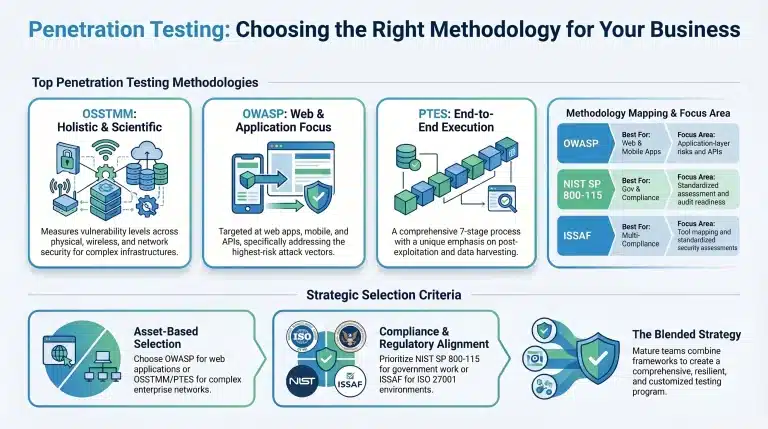
OSSTMM (Open-Source Security Testing Methodology Manual) Best for: Network, physical, and operational security assessments
OSSTMM has been developed by ISECOM and is perhaps the most detailed and science-oriented penetration testing methodology. Unlike other methods that limit themselves only to digital technologies, OSSTMM takes a more holistic approach and covers such aspects as physical security, wireless communication, telecommunication, people, and networking.
Attack surface measurement is one of the advantages of the framework. With it, organizations can actually measure their vulnerability levels instead of just documenting them. In addition, because OSSTMM is mentioned in the context of ISO 27001 compliance, it is highly recommended for complex infrastructures.
-
OWASP Testing Guide Best for: Web applications, mobile apps, and API security
OWASP (Open Web Application Security Project) is believed to be the most effective one when it comes to testing an industry. The OWASP Testing Guide contains many tests for revealing vulnerabilities which are able to threaten not only web applications but also mobile devices and APIs.
As it is well-connected to the OWASP Top 10, it allows companies to determine the highest risks that affect their apps. It is especially helpful for the web application penetration testing and supports the work of development teams and the DevSecOps methodology.
One more thing that distinguishes the OWASP framework is that it is based on the work of the community. The project regularly updates its methodologies in connection with the emergence of new attack vectors. For example, now it includes the security of LLMs.
For best results, OWASP is often combined with broader frameworks like PTES or NIST to cover full-spectrum security testing.
-
PTES (Penetration Testing Execution Standard) Best for: Structured, end-to-end penetration testing engagements
Penetration testing execution standard (PTES) describes the step-by-step procedure for doing professional penetration testing by breaking the whole test down into seven main stages: pre-engagement interaction, reconnaissance, threat modeling, vulnerability analysis, exploitation, post-exploitation, and report.
The unique aspect about PTES is the emphasis it places on post-exploitation; this phase takes into consideration what takes place after a successful attack has occurred. Lateral movement, establishing a foothold, and harvesting data are some of the activities that occur during this phase.
This test has made a significant impact in regulated industries including finance and insurance sectors because of its ability to document everything systematically.
-
NIST SP 800-115 Best for: Government, compliance-focused organizations, and regulated industries
The framework SP 800-115 was published by the National Institute of Standards and Technology (NIST). SP 800-115 divides the testing phase into four main stages, namely planning, discovery, attack, and reporting.
Perhaps the most important attribute that makes it a superior framework is its emphasis on credibility and compliance. By meeting NIST requirements, an organization can show that it meets international security standards, something very desirable in terms of audits and regulations.
While many security testing frameworks prescribe their methodologies, NIST SP 800-115 gives guidance which can be easily adapted by any enterprise.
-
ISSAF (Information Systems Security Assessment Framework) Best for: Tool mapping and multi-compliance environments
NIST SP 800-115 is a security test document released by the National Institute of Standards and Technology. It is a highly popular document among many businesses and is normally adhered to by companies that require a standardized form of security assessment.
NIST is more focused on planning, documentation, and security assessments than other types of technical penetration testing frameworks. Due to its focus on assessment and planning, it is normally adopted by compliance-minded companies.
The process normally involves four key stages; namely, planning, discovery, attack, and reporting. Companies that wish to get ready for audits normally follow NIST-based techniques due to their consistency.
A good thing about NIST is its flexibility. Companies have the liberty of using the framework in line with their specific infrastructure and business environment.
Companies that include government contractors, enterprises, and organizations managing sensitive data normally use NIST frameworks.
Choosing the Right Methodology for Your Organization
No single penetration testing methodology is universally superior. The right choice depends on several factors:
- What you’re testing: Web applications call for OWASP; complex enterprise networks benefit from OSSTMM or PTES.
- Your compliance obligations: NIST SP 800-115 is the obvious choice for government and federal work; ISSAF aligns well with ISO 27001.
- Your testing cadence: Organizations running regular, repeatable tests benefit from the structured phases of PTES or NIST.
- Your team’s maturity: Experienced teams often blend methodologies, using PTES for overall structure, OWASP for application testing, and NIST for compliance documentation.
In practice, the most effective security teams don’t treat these frameworks as competing options. They treat them as complementary tools, drawing on the strengths of each to build a comprehensive, resilient testing program for vulnerability assessment and penetration testing.
Conclusion
Penetration testing methodologies help organizations to perform security assessments in a more structured and effective way. Frameworks such as OSSTMM, OWASP, PTES, NIST SP 800-115 and ISSAF provide businesses with a reliable approach towards identifying vulnerabilities and improving cybersecurity practices.
As security constraints differ from one organization to another, many businesses combine multiple approaches based on their infrastructure and compliance needs. IBN Technologies helps organizations to choose suitable penetration testing approaches and strengthen their cybersecurity services through industry-based security assessment practices and risk management support.
Don’t wait for a cyberattack to expose vulnerabilities- secure your business today with penetration testing support from IBN Technologies.
Need VAPT Services for your 2026 project?
Get a free consultation with our tech team — no commitment.
FAQs
Q1. Which penetration testing methodology is commonly used?
The most used penetration testing methodology includes OWASP which is often used for the testing of web applications and APIs. Many organizations also opt for PTES and NIST frameworks.
Q2. Which penetration testing framework is best for compliance purposes?
The two commonly recommended penetration testing methodologies are NIST SP 800-115 and ISSAF since they help organizations meet different regulations including ISO 27001.
Q3. Is it possible for an organization to use more than one penetration testing methodology?
It is possible and often happens as organizations try to develop an effective penetration testing procedure from combining different frameworks including OWASP, PTES and NIST.