You update your systems regularly, but do you test how secure they really are?
Every new cloud deployment, remote access point, public-facing application, or infrastructure update increases your organization’s exposure to potential threats.
External penetration testing allows businesses to detect vulnerabilities in their online properties before malicious users have a chance to exploit them. In contrast to automated vulnerability scanning, this takes things one step further in proving that these vulnerabilities can be exploited to penetrate the system.
Below are the 7 critical signs your organization needs external penetration testing, and why acting early can make a significant difference.
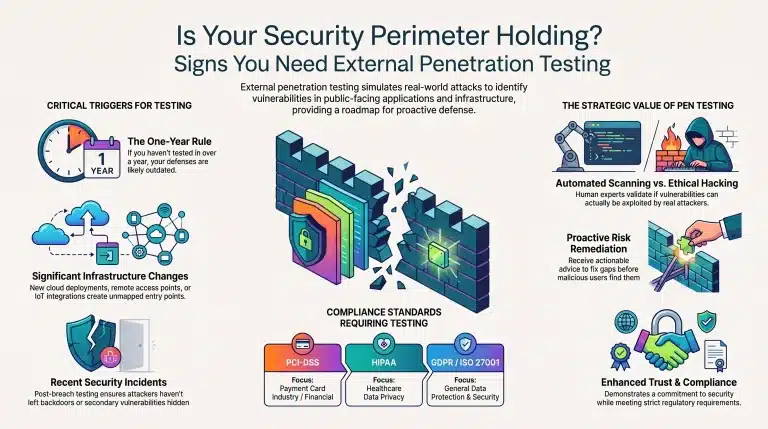
- You Haven’t Tested Your Security in Over a Year
The cybersecurity environment is dynamic, always new approaches of attacking appearing all the time. If you have not run a network penetration test within the last year, your system could be vulnerable to cyber threats.
Old security measures may fail to address these weaknesses. Conducting regular penetration tests helps keep your defenses up to date.
- You Recently Launched a New Application or System
Whenever you adopt a new application, website, cloud platform, or infrastructure, it leads potential entry points for attackers.
Even well-developed approaches can contain hidden mistakes. Executing web application penetration testing or cloud security testing services helps to identify issues before they are exploited in production.
- You’re Handling Sensitive Customer Data
If your company handles or stores sensitive data like personal data, financial data, or healthcare data, then your company is very much at risk of a cyber-attack.
A cyber-attack can cause you to incur losses that are financial, legal, and also reputational. Ethical hacking services will protect you from such cyber-attacks.
- You Need to Meet Compliance Requirements
Compliance testing may be necessary for some companies depending on the regulation standards which include the following:
- PCI-DSS – Payment Card Industry Data Security Standard
- HIPAA – Healthcare
- GDPR – Data Protection
- ISO 27001
It’s important to have penetration testing compliance for any company required to follow these standards. External penetration testing provides an unbiased report.
- Your Internal Security Team Lacks Resources or Expertise
Internal IT teams are usually preoccupied with day-to-day activities, resulting in little time to conduct comprehensive security tests. Furthermore, they lack the necessary tools and expertise to perform such advanced simulations.
Hiring external penetration testing companies provides access to expert ethical hackers who bring fresh perspectives and advanced methodologies.
These experts can reveal weaknesses that internal teams would be unable to spot.
- You’ve Experienced a Security Incident Recently
It is an obvious red flag for your company if there has been any kind of cyber-attack, data breach, or ransomware.
But it is not enough to fix only the apparent problem because attackers might leave backdoors and use multiple vulnerabilities.
An overall vulnerability assessment and penetration testing (VAPT) is essential in such situations.
- Your Network Has Grown or Changed Significantly
Organizations constantly change adding new users, devices, endpoints, and remote access systems. Each change increases the attack surface.
If your organization has expanded its digital footprint, it’s time to reassess security with external network penetration testing.
This includes:
- Remote workforce access systems
- Cloud infrastructure
- IoT devices
- Third-party integrations
Without testing, these changes can create unnoticed vulnerabilities.
Why External Penetration Testing Matters
Attackers are always looking for exposed systems and security vulnerabilities. It is dangerous for you to wait until the time of attack to test your perimeter security since this will cause you financial harm.
The value that external pen testing offers to businesses includes:
- Simulation of real-world attacks
- The validation of your security measures
- Based on risk, remediation advice
- Increased compliance preparedness
- Increased confidence in the Internet-facing infrastructure
This goes beyond just uncovering potential vulnerabilities; rather, it shows how they could be exploited by attackers.
Benefits of External Penetration Testing
Investing in penetration testing services offers several advantages:
- Proactive risk identification: Discover vulnerabilities before attackers do
- Improved compliance: Meet regulatory and industry requirements
- Enhanced customer trust: Demonstrate commitment to data security
- Reduced risk of breaches: Strengthen overall security posture
- Actionable insights: Get detailed remediation recommendations
Final Thoughts
Cybersecurity threats are evolving rapidly, making proactive security essential for every organization. If your business exhibits any of these signs, investing in external penetration testing services is a smart step toward preventing costly breaches and ensuring business continuity.
IBN Technologies is a trusted provider of cybersecurity services, supporting businesses across industries with effective VAPT solutions. Our expertise aids organizations to identify vulnerabilities, reduce risks, and enhance their security posture.
For reliable cybersecurity audits, we offer comprehensive services along with a VAPT cost guide that helps businesses recognise key pricing factors and make informed decisions.
Connect with our cybersecurity experts today to discuss your requirements and discover how IBN Technologies can help secure your business.
Need VAPT Services for your 2026 project?
Get a free consultation with our tech team — no commitment.
FAQs
Q1: What is the main difference between automated vulnerability scanning and external penetration testing?
Vulnerability Scan is an automated software, which identifies potential vulnerabilities in your network. An External Pentest is much more thorough; it includes manual work from ethical hackers, who attempt to exploit identified vulnerabilities to see how far they can get into your system.
Q2: How often should our organization conduct an external penetration test?
Ideally, you should conduct an external pentest annually. But, of course, you need to repeat it when there are any major changes in your environment, for example, when moving to the cloud, launching a new app, or updating your infrastructure.
Q3: Can an external pentest disrupt our daily business operations or cause downtime?
No. Top pentest organizations conduct themselves with great care when scoping and conducting the simulation to avoid any sort of disruptions to your productive environment. Pentests are conducted in such a manner that no alteration or shutdown of systems is done during testing.
Q4: Will an external penetration test satisfy our compliance requirements (like SOC 2, PCI-DSS, or HIPAA)?
Absolutely. An external penetration test will give you an unbiased and third-party Attestation of Summary. It is this document that gives you the final and audited certification that is needed by regulatory frameworks.