Cyberattacks have now become unpredictable, happening even after business hours; however, it will be too expensive for businesses to operate their security operation center on a round-the-clock basis. Setting up a SOC in physical infrastructure requires huge investment in technology, purchasing SIEM and SOAR licensing, and hiring a team of tier-1 to tier-3 security analysts.
Virtual SOC (vSOC) is the answer to this problem. It delivers enterprise-level security monitoring and threat detection and incident response in a decentralized manner, leveraging cloud-based architecture.
What is a Virtual SOC (vSOC)?
A virtual SOC refers to a cybersecurity operations center hosted in the cloud where the network infrastructure, endpoints, and cloud environments are connected to a remote team of security professionals along with intelligent monitoring tools.
Virtual SOC is not like a traditional SOC, which involves a central command room with all the hardware monitors along with on-site servers. It makes use of current Security Operations as a Service (SOCaaS) delivery system to transmit security event logs, perform analytics on threats, and automate response processes from anywhere in the world.
Virtual SOC vs. Traditional Physical SOC
On premises vs. virtual SOC comes down to budgeting, resources, and deployment speed.
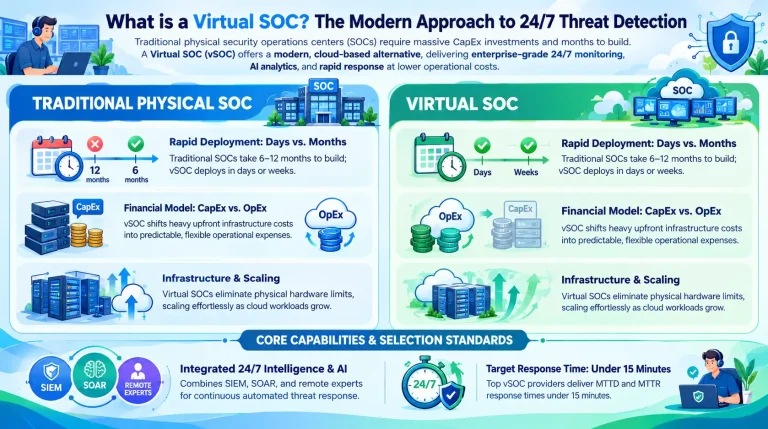
The conventional SOC depends on the use of physical on-site hardware infrastructure, physical command centers, and fixed server farms. The time required to build an in-house SOC can vary from 6 to 12 months because of the physical construction of a facility, hardware installation, and tool integration process. There is a necessity for significant investment at the initial stages and ongoing operational expenses. The scaling of a physical SOC is complicated because of the physical limitation of space in the room and hardware resources.
In Contrast, virtual SOC runs entirely from a cloud-based, decentralized portal where there is no need for any form of physical hardware. Deployment is very quick and can take days or weeks depending on how cloud connectors and APIs are integrated. There is also a change in the financial structure from CapEx to OpEx, which is predictable. It is flexible and scalable, meaning it allows organizations to scale up their monitoring as cloud workloads increase. Lastly, a virtual SOC provides easy access to specialized security experts.
Core Components of a Modern Virtual SOC
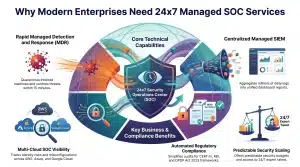
An all-in-one virtual SOC creates a defense network through the use of various tools such as SIEM and Log Aggregation that help aggregate data from various sources such as firewalls, cloud applications, and user machines to a single console; AI & Machine Learning Analytics that helps create baselines and filter alert volumes; Automated Incident Response (SOAR) that helps automatically deploy containment plans; Continuous Threat Intelligence that helps block vulnerabilities such as zero-day exploits proactively, and Remote Security Experts that help provide human-in-the-loop expertise for analysis and investigation.
Primary Benefits of Implementing a Virtual Security Operations Center
The Virtual SOC allows companies to cut down on security costs while offering them continuous security monitoring and security professionals without having to establish their own Security Operations Center. Furthermore, the Virtual SOC also enables continuous compliance monitoring by means of automatic log management and reporting. Consequently, companies are able to improve their security status and remain compliant at all times.
How to Choose the Right Virtual SOC Provider
During an evaluation of vSOC service providers or SOC as a Service companies, some key considerations should come into play. Firstly, think about the question of the compatibility of integrations so that the provider would be integrated natively with your technology stack whether it is AWS, Azure, Google Cloud, Microsoft 365, or EDR agents. Secondly, look at what kind of SLAs these companies have in terms of the reaction time, especially MTTD and MTTR under 15 minutes. Thirdly, consider the transparency of their pricing models and whether they are based on log volume, user endpoint, or seat-based pricing.
Protect Your Organization 24/7 with IBN Technologies
A solution for 24/7 threat monitoring and compliance that is enterprise-class does not need to involve a multi-million-dollar brick-and-mortar operation. Through the combination of automated AI and seasoned security engineers, IBN Technologies provides Virtual SOC services to suit your requirements.
Want to strengthen your defense posture? Contact the cybersecurity experts at IBN Technologies today to request a free consultation and explore our managed Virtual SOC solutions.
Need Managed SOC and SIEM Services for your 2026 project?
Get a free consultation with our tech team — no commitment.
Frequently Asked Questions
The typical implementation time of a virtual SOC integration varies anywhere from a few days to a few weeks, through cloud API and lightweight software agents that enable direct integration with your current environment.
MDR is mainly concentrated on endpoint security and malware containment, while the Virtual SOC covers the entire environment of yours, comprising networks, cloud, user access management, and even reporting.
Yes. Virtual SOCs are designed to be cloud-native and are thus more capable of monitoring hybrid and multi-cloud systems compared to hardware-dependent physical SOCs.