Most web applications are built with performance, features, and user experience in mind. Security often gets attention only when a compliance requirement appears or a potential threat is discovered. Unfortunately, that’s also when vulnerabilities become expensive to fix.
A well-executed VAPT helps organizations to detect weaknesses before attackers do. But what exactly does a web application penetration testing cover, and why is it such a critical part of cybersecurity? Let’s break it down.
What Exactly Gets Tested in a Web Application?
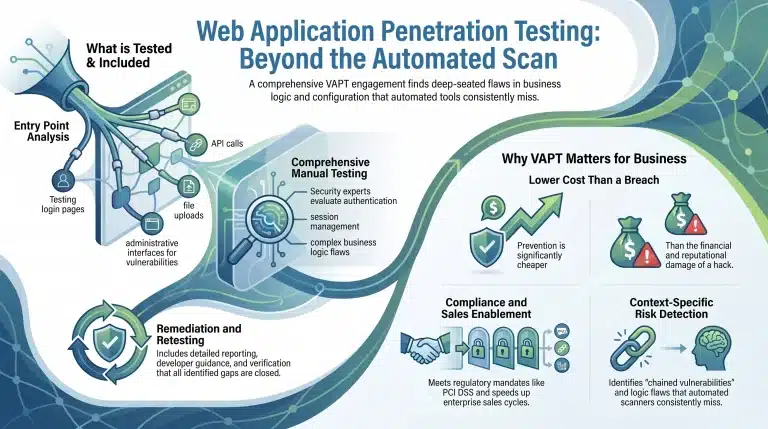
A web application has many different entry points that can be attacked by hackers through various channels, such as the login page, user account, API calls, file upload facility, database, and administrative interface. A minor vulnerability in any of these interfaces can result in an exploit that causes the system to be breached or put at risk of compromise.
The objective of web application VAPT is to look into these interfaces for discovering the vulnerabilities in them as well as validating the controls implemented, which helps in finding out the actual threats and vulnerabilities in the application.
What’s Included in a Web Application Penetration Testing Engagement?
Comprehensive web application vulnerability assessment includes testing that is more than automated scanning, which examines the possibilities that hackers have to exploit vulnerabilities within the application. The testing process usually involves areas such as authentication and session management, access control, input validation, APIs, business logic, and server configuration. Security experts examine whether users are able to exploit applications.
The engagement also includes client-side security checks, detailed vulnerability reporting, and remediation guidance to help development teams address identified risks. Once fixes are implemented, retesting is performed to verify that vulnerabilities have been successfully resolved and that no new security gaps have been introduced.
Why Web Application Actually Matters for Your Business
It’s easy to treat VAPT as a box-ticking exercise, especially when budgets are tight. But a few realities make it worth taking seriously.
Web apps are the front door attackers try first.
They’re internet-facing by design, handle sensitive data, and are updated constantly, every new feature is a new opportunity for something to slip through. That combination makes them one of the most targeted parts of any organization’s infrastructure.
Automated scanning alone gives you a false sense of security.
Scanners are great at catching known, signature-based issues quickly and cheaply. What they consistently miss are business logic flaws, chained vulnerabilities, and context-specific risks exactly the kind of issues a real attacker would go looking for. Relying on scan results alone means you’re only seeing part of the picture.
Compliance frameworks increasingly expect it.
Depending on your industry, regulators and standards RBI, SEBI, IRDAI, PCI DSS, ISO 27001, and India’s DPDP Act among them, either mandate or strongly recommend periodic security testing for applications handling sensitive data. A documented VAPT report is often the evidence auditors want to see.
A breach costs far more than prevention ever will.
Beyond the direct financial hit, there’s the damage to customer trust that’s much harder to repair. Customers who lose confidence in how you handle their data don’t always come back, even after the technical issue is fixed.
Enterprise clients are starting to ask for it upfront.
If you’re selling to larger businesses or handling their data, don’t be surprised when a security questionnaire or a recent VAPT report becomes part of the deal-closing conversation. Having one ready, rather than scrambling to get one, can genuinely speed up sales cycles.
Questions to Ask Before Signing a VAPT Agreement
Some simple questions to differentiate a serious vendor from a “scanner-in-the-box” service:
- Does the service involve manual testing, or is it just automated testing?
- Is there an inclusion of business logic testing in the contract, or technical vulnerability assessment only?
- Is retesting included in the deal, or will it be extra?
- Do they provide you with an example of their reports in order for you to be able to assess the quality of their work beforehand?
- Do they have experience working within your specific tech stack and industry?
Final Thoughts
Web application penetration testing are dynamic systems, and as such, you will always be developing new capabilities, building integrations, and updating code continuously, thus your threat landscape changes continually along with it. A professional VAPT engagement cannot be simply an audit that you will store in some drawer. It has to be a stress test on how your application would fare against a real attacker who tries to breach it, from logging vulnerabilities to business logic flaws and API misconfigurations.
If done right, this would provide you with a much more useful output than mere compliance, namely, the certainty that no such weaknesses will greet an attacker who would want to exploit them.
Need VAPT Services for your 2026 project?
Get a free consultation with our tech team — no commitment.
Frequently Asked Questions
Automated scanning finds vulnerabilities, but manual VAPT helps to discover complex security vulnerabilities, business logic vulnerabilities, and attack vectors which automated scanners can't detect.
Yes. Retesting will ensure the vulnerabilities found are resolved and there aren't any new vulnerabilities created aduring the process.
The minimum frequency is annually. However, VAPT is also necessary after each major update and infrastructure change of an application.
The frameworks and standards like PCI DSS, ISO 27001, DPDP Act, RBI, SEBI, and IRDAI may include the requirement to perform VAPT regularly.