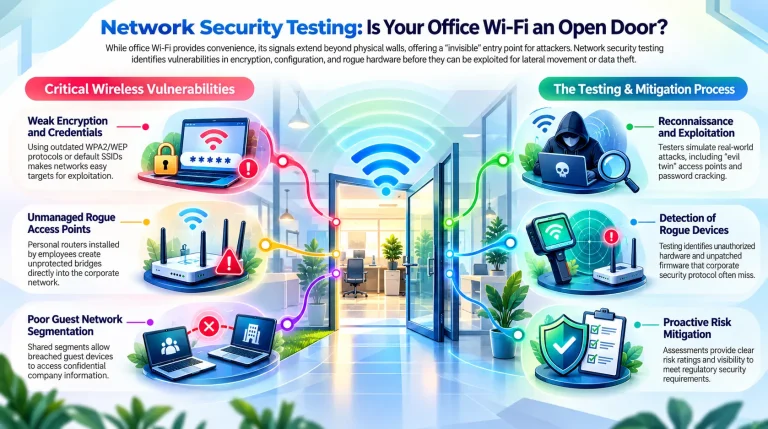
Wireless Network Security Testing: Is Your Office Wi-Fi an Open Door for Intruders? Your office Wi-Fi may be protected by a strong password and modern access points, yet still expose your business to unauthorized access, credential theft, rogue devices, and lateral movement. Wireless Network Security Testing helps determine whether attackers within radio range can exploit weaknesses in your Wi-Fi infrastructure before those weaknesses become a breach.
Why Office Wi-Fi Needs Security Testing
Wi-Fi networks from the office can reach areas outside the office environment, making it easier for hackers to communicate with your network without stepping inside the premises. A wireless security assessment tests encryption, authentication, network segmentation, access point settings, threats from rogue devices, and ways to penetrate the internal network.
Wireless penetration testing is an assessment technique where hackers attempt attacks on your network to see if they can penetrate your network and access any sensitive information stored in it.
How Office Wi-Fi Can Become an Easy Target for Cybercriminals
Organizations spend a lot on their firewalls, endpoints, and cloud security solutions but neglect wireless security. Sadly, hackers usually consider Wi-Fi networks the easiest way to gain access into an organization’s network.
Wi-Fi signals span beyond any physical barrier, so the attackers will be able to try to break into your network even when they are outside the office premises. On the other hand, there is the rise in the use of personal devices, smart printers, surveillance cameras, IoT gadgets, and conferencing equipment.
The very same reason that makes Wi-Fi appealing to the employees of the organization is what makes it appealing to attackers. This means that a poorly configured access point and poor configuration of authentication settings could give them an entry point into the network.
Common Vulnerabilities Found During Wireless Security Testing
In the wireless testing process of office networks conducted by security professionals, the following types of vulnerabilities occur again:
- Weak or outdated encryption
The networks, which still use WPA2 (or even worse, WEP) encryption, are easier to hack than networks with WPA3. Even if the encryption is strong enough, the weakness in the form of the weak Wi-Fi password will undermine it completely.
- Default credentials and general SSIDs
The network that uses default logins as the administrator login or default SSID such as “NETGEAR” and “Office-WiFi” is easily exploitable and shows that the network security is non-existent.
- Rogue access points
The problem of dead spots is frequently encountered in large firms when a user installs a personal router or repeater as a means of resolving the issue. In this case, the gadget is normally unmanaged and thus unprotected by corporate security protocols, thereby providing access directly to the corporate network.
- Guest network segmentation
When guest Wi-Fi uses the same network segment as an internal one, a guest computer that has been breached becomes an open door to confidential company information.
- Outdated firmware
Networks whose devices remain unpatched can be attacked through exploits that could have been fixed- but only if the patch had been applied.
- Insecure protocols
WPA2/3-Enterprise network configurations with poor configuration, WPS services left open, or pre-shared keys that can be guessed provide the means of attack.
What Wireless Network Security Testing Actually Involves
Penetration testing wireless is not one test but an entire process where the tester simulates what an actual hacker would do to the target network:
Reconnaissance: The tester discovers all wireless networks that can be seen from inside and outside the office environment, assessing how much distance your network signal can travel.
Vulnerability scanning: Encryption protocols, access methods, and configuration of access points are tested for vulnerabilities.
Exploitation tests: The tester will attempt to hack Wi-Fi passwords, capture data from the airwaves, create a fake access point (a “twin evil” attack) or exploit misconfigurations – as any real attacker would do.
Detection of rogue devices: Access points and devices which shouldn’t exist in the network are discovered by testers.
Reporting and mitigation: Recommendations and risk ratings are made based on specific weaknesses found, using language that makes sense to anyone.
Penetration tests can be grouped according to the amount of information the tester has before the test begins: black box (complete ignorance, modeling an external attacker), white box (all the details of the network are known, modeling an internal attacker), and grey box (somewhere in between).
Some of the common tools used for this purpose include Aircrack-ng, Kismet, and Wireshark, among others, which can be executed from a Kali Linux system – tools which can capture and analyze wireless traffic.
Benefits of Regular Wireless Security Assessments
Wireless security assessments conducted on a regular basis allow organizations to spot potential weaknesses, rogue devices, improve network segmentation, and test security controls before malicious actors take advantage of them. Conducting regular security assessments allows for better visibility of threats in the wireless environment and helps meet regulatory requirements. But most importantly, regular assessments allow an organization to be proactive about wireless security issues.
Conclusion
An unprotected Wi-Fi network may become a way into the corporate network system due to the lack of wireless security measures. Unsecure access points, authentication issues, rogue devices, and network segmentation are some of the examples of risks that may lead to the breach of the network.
To check these issues, you should conduct wireless network security testing. We offer Wireless Security Testing and VAPT Services to ensure the security of your Wi-Fi environment.
Need VAPT Services for your 2026 project?
Get a free consultation with our tech team — no commitment.
Frequently Asked Questions
Wireless network security testing should be performed at least annually. Additional testing is recommended after significant infrastructure changes, when new locations are added, or when new IoT or BYOD policies are implemented.
Professional wireless security testing is designed to minimize disruption. Testing methods such as passive signal mapping and controlled exploitation can typically be conducted without causing network downtime when properly planned and authorized.
A vulnerability scan identifies and reports potential security weaknesses, while a wireless penetration test goes further by safely validating whether identified vulnerabilities can actually be exploited to gain unauthorized access to the network.