Today, mobile applications are an essential part of business processes that range from instant messaging to mobile banking, online shopping, and enterprise-level operations. However, as the usage of mobile applications increases, their attractiveness for cyber criminals grows.
The security issues cannot be considered as something additional for the contemporary business environment anymore. Mobile Application VAPT Services is a proactive security process designed to uncover, evaluate, and remediate technical weaknesses across Android and iOS applications before attackers can exploit them.
What are the Core Components of Mobile Application VAPT Services ?
Mobile Application VAPT is more than just a simple vulnerability scan test. It is an alternative to that which comprises a few tests designed to evaluate the security of your application from different angles.
- Static Application Security Testing (SAST)
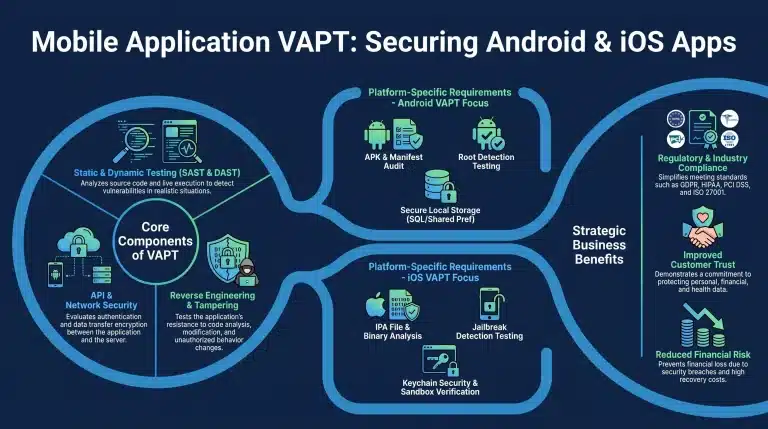
SAST is a type of analysis carried out on the source code and compiled code of the application to determine the security vulnerabilities of the application during its development process. This technique helps detect the coding errors, security vulnerabilities, and passwords that could create risks for the application.
- Dynamic Application Security Testing (DAST)
DAST tests the application when it is being executed. Security professionals can detect vulnerabilities that could be detected only during the execution of the program because of the testing of the application in realistic situations.
- API Security Assessment
With mobile applications depending so much on APIs for communication of data, it becomes necessary to ensure API security. Security assessments of APIs entail determining any vulnerabilities that exist in relation to authentication, authorization, and data exposure among others.
- Network Security Testing
Mobile applications constantly interact with the server. Network Security Testing tests the interactions between the mobile application and the server to determine whether there are any weaknesses in terms of insecure data transfer or weak encryptions.
- Authentication and Session Management Testing
Effective authentication is key to securing the user accounts and the company’s information. The test seeks to authenticate the login processes, the session management, access controls and security of the account.
- Reverse Engineering and Tampering Analysis
Hackers will often try to reverse engineer mobile applications to find out information or alter application behavior. This test is done to evaluate the application’s resistance to code analysis, modification, and tampering.
Platform-Specific VAPT: Android vs. iOS
As one of the most popular mobile platforms, Android, comes with specific security threats because of its open nature and the diversity of device environments. Android Application VAPT is one of the services that will help you detect specific vulnerabilities of your platform and improve your application security.
Android Application VAPT
APK File & Manifest Audit: APK file & Manifest analysis: Analysis of the compiled DEX bytecode and audit of the AndroidManifest.xml file to detect improper exposure of the application components.
Root Detection Mechanism Testing: Verify whether security mechanisms can be bypassed on a rooted phone.
Secure Local Storage Assessment: Whether any sensitive information like tokens or user authentication details are stored in plain text in Shared Preference or in local SQL databases.
Code Obfuscation & Permissions: Assessing various methods of code obfuscation, including ProGuard or R8 and permissions testing to ensure no additional permissions are granted.
Malware & Tamper Resistance: Ensuring that application can deal with injection threats and side loading.
The security team also tests the working of the application on a rooted phone and possibility of bypassing security controls.
iOS Application VAPT
Although Apple has stringent security measures embedded in the iOS framework, its applications can still be vulnerable to programming mistakes and logic failures. An example of what constitutes an iOS VAPT testing process would include:
- IPA File Analysis: Checking for essential security compiler flags in the Mach-O binary, such as PIE, ASLR, and Stack Canaries.
- Keychain Security Evaluation: Guaranteeing that the passwords and keys used by the application are securely kept in the iOS Keychain using proper accessibility flags.
- Jailbreak Detection Testing: Ensuring that the application can detect whether it is operating on a jailbroken device.
- Application Sandbox & Transport Verification: Verifying that all policies of ATS have been followed and also encrypting local sandbox data like .plist and CoreData files.
- Runtime Protection Review: App behavior testing during runtime with dynamic analysis and debugging.
Key Benefits of Regular Mobile VAPT
When the security of mobile applications is seen through the lens of a business process, some strategic benefits arise, and these are listed below:
- Security Gains: Aids in uncovering any vulnerabilities within your application and helps in securing them before they are exploited and become an open source for any attack.
- Improved Customer Trust: Builds trust with the customers as it ensures that you take all necessary precautions to protect your customers’ personal, financial, and health data.
- Regulatory & Industry Compliance: Simplifies compliance to many technical aspects as per different standards, including GDPR, HIPAA, PCI DSS, and ISO 27001.
- Reduced Financial Risk: Prevents any financial loss due to breach and cost of recovery.
- Vulnerability Mitigation: Gives timely and prioritized reports with technical guidance to help the developer in fixing any vulnerabilities.
- Protection Against Emerging Threats: It ensures that your application is safe from any new vulnerabilities.
Final Thoughts
As the mobile applications continue to be the driving forces behind the growth of enterprises, the need for proactive security testing becomes increasingly important to ensure the protection of confidential user information, comply with different regulatory requirements, and safeguard business reputation. In case you have either created your mobile application or wish to enhance the security of the existing one, our Mobile Application VAPT Services will help you gain technical expertise that will help you identify vulnerabilities and secure your application.
IBN Technologies can help you and your organization identify and mitigate security risks by performing a VAPT assessment. We have mobile application security experts who will make sure that your mobile app is secure and complies with industry standards.
Need Mobile Application VAPT Services for your 2026 project?
Get a free consultation with our tech team — no commitment.
Frequently Asked Questions
Mobile Application Vulnerability Assessment & Penetration Testing (VAPT) refers to a security approach that detects, assesses and mitigates technical vulnerabilities present within Android and iOS apps before such vulnerabilities can be exploited by hackers.
The engagement process normally takes between 1 to 3 weeks, considering the size and complexity of the mobile application being tested. The factors affecting the timeframe are numerous custom API endpoints, role-based access control levels, presence of both Android and iOS builds, as well as source code accessibility (Black-box versus Grey-box testing).
The mobile application depends heavily on the server and APIs to exchange data. The purpose of the testing process is to make sure that any transmission of data is encrypted and that there are no authentication or authorization security issues.
There are many advantages from regular VAPT testing, including preventing data breaches and maintaining customers' trust, as well as following GDPR, HIPPA, and PCI DSS requirements.