Do you believe that your business is impossible to penetrate and entirely safe from any form of cyber-attack, or do you feel that somewhere within it, there is some flaw that can be exploited by the hacker for his benefits? With cyber-attacks becoming more sophisticated in nature today, companies need to take steps other than conventional ones to secure themselves.
Penetration testing plays a vital role here in helping companies discover their security vulnerabilities well in advance. In this blog post, we will explore various kinds of penetration test services and factors to consider while choosing the right service.
What Is a Penetration Test Service?
Penetration test service, alternatively known as “ethical hacking,” is a service whereby a simulated cyberattack is conducted on the client’s computer system. The main aim is to uncover any weaknesses in their network architecture that may possibly be used to exploit them later on by other hackers.
What Are the Major Types of Penetration Test Services?
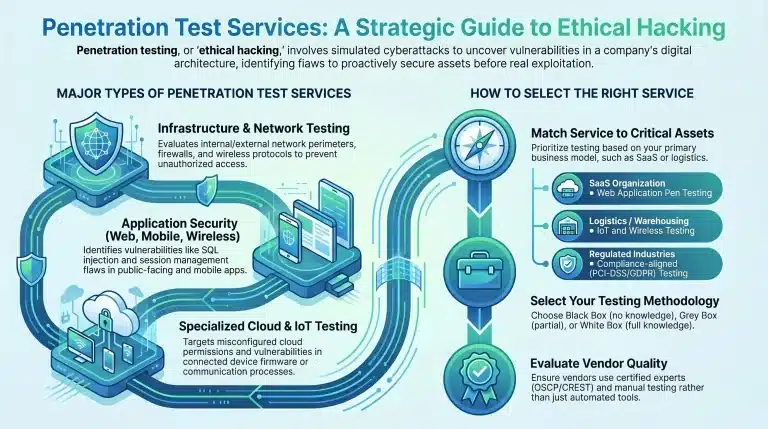
Penetration tests comprise several different types of tests, all aimed at assessing the level of security within various aspects of the digital infrastructure of an enterprise. These are the seven types of penetration test services you should know about:
- IoT Pen Testing
With increased use of connected devices by businesses, the Internet of Things (IoT) has become a massive target. Through IoT Pen Testing, the security of these devices is guaranteed since it helps identify any weaknesses in their physical form, firmware, and communication processes to prevent unauthorized access and data breaches.
- Cloud Pen Testing
Cloud computing faces threats such as misconfigured permissions, vulnerable APIs, and poor access control. The purpose of Cloud Pen Testing is to test cloud platforms like AWS, Azure, and Google Cloud against security issues and compliance.
- Network Penetration Testing
This type of penetration test service aims at your network structure. It seeks out any weaknesses in your internal and external networks.
- External: Targets your perimeter (firewalls, routers).
- Internal: Mimics what would happen if an attacker penetrated your office through your firewall or even through your virtual private network.
It will check your firewalls, servers, open ports, and network protocols to avoid unauthorized entry and lateral movement. It is the core of cybersecurity.
- Wireless Penetration Testing
Wireless networks are often easy targets if not properly secured. This testing attempts to crack WPA3 encryption, identifies rogue access points, and ensures that your guest Wi-Fi can’t be used to hop over into your secure corporate data.
- Wireless Application Pen Testing
Wireless network security may easily be compromised unless appropriate measures are taken to protect them. The wireless app pen testing aims at breaking the WPA3 encryption, finding any rogue access point, and making sure your guest Wi-Fi does not provide access to your business information.
- Web Application Pen Testing
Web apps can be accessed publicly, making them the most vulnerable to attacks. The web application pen testing involves identifying vulnerabilities such as SQL injection, cross-site scripting (XSS), and broken authentication to secure user data and application functionality.
- Mobile Application Pen Testing
As the use of mobile phones increases, testing mobile apps for security becomes crucial. Mobile application pen testing identifies any vulnerabilities associated with the way the app stores information on the phone, the way the app connects with the server, and the way the code could be “reverse-engineered” by the attacker, API weaknesses, and session management in both iOS and Android applications.
How To Choose the Right Type of Penetration Test Services?
Most organizations do not require all types of penetration test services each month. The key is to strategically choose the right tests based on your infrastructure, risk level, compliance needs, and business priorities.
- Match the Service to Your Asset
Firstly, you should begin with knowing what is to be protected, whether it is your website, cloud environment, mobile application, or network. You should pick up a testing service according to your vital assets.
For example, if you work for a SaaS organization, then Web Application Pen testing comes first on the list. Similarly, if you work for a logistics company and have warehouses full of connected scanners, then IoT and wireless testing become your priority.
- Identify Industry Requirements
Always consider the rules and regulations that bind your organization before embarking on any tests, as each industry has its own set of guidelines like GDPR, PCI-DSS, or ISO standards. Make sure the penetration testing service is in line with all necessary standards in your industry.
For instance, if you are dealing with credit card information, PCI-DSS dictates that your network needs a certain type of penetration testing.
- Choose Methodology
Know whether the provider uses manual testing methods, automated testing methods, or both. The use of both types of testing methods normally yields the best results.
In addition to the information provided above, you must know what level of insider knowledge you want to share with the tester:
- Black Box – No knowledge (Testing as an unknown hacker).
- Grey Box – Partial Knowledge (Testing as a regular user).
- White Box – All knowledge/Source code available (Best auditing method).
- Evaluate The Vendor
Do not blindly choose the cheapest vendor. The best vendor must be able to offer:
- Certified Experts: Check for certifications such as OSCP and CREST.
- Manual Testing: They should not be using any cheap, $100 automated tools.
- Practical Recommendations: A report that does not include practical recommendations is meaningless.
Conclusion
Choosing the correct penetration test service from among the seven different types will help you make sure that your digital environment is appropriately tested and safeguarded against any possible cyber threat. It requires a clear strategy that will match the testing services with your most important business components and industry standards.
Having more than 26 years of experience in the field of IT and cybersecurity, IBN Technologies is an acknowledged global player that provides thorough and certified penetration tests for companies seeking to outsmart cyber criminals.
To secure your business, contact IBN Technologies today!
Need VAPT Service for your 2026 project?
Get a free consultation with our tech team — no commitment.
Frequently Asked Questions
- What is the frequency of performing penetration testing?
Penetration testing should be done frequently, especially after any major modifications to the infrastructure, applications, and compliance mandates.
- Are there any requirements for penetration testing services for compliance?
Yes, compliance regulations like PCI-DSS, ISO 27001, and HIPAA advocate for penetration testing.
- What types of tools are used in penetration testing?
The tools used by penetration testers include network scanners, vulnerability analyzers, password crackers, application testers, and exploitation simulators.
- Does penetration testing affect business operations?
Professional penetration testing is conducted in a well-organized and controlled manner to avoid disrupting business operations.