As organizations grow on AWS, security threats become more complex Misconfigured IAM roles, exposed S3 buckets, and vulnerabilities within APIs have now emerged as some of the most common ways to compromise your organization.
The use of traditional security audits is no longer enough. Businesses need to take advantage of advanced AWS penetration testing methods to comply and be resilient.
At IBN Technologies, we offer professional AWS penetration testing solutions that can help keep your organization protected.
What is AWS Penetration Testing?
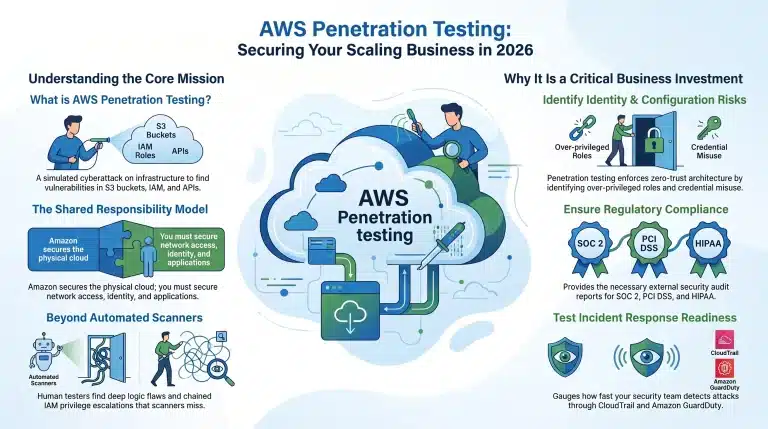
AWS Penetration Testing is the process of performing actual cyberattack simulation on your AWS infrastructure to find possible vulnerabilities before they could be used by any hacker. Security experts perform checks on important components like misconfigured S3 buckets, IAM policies, exposed services, and application or API security.
The key idea behind penetration testing for AWS is to discover potential vulnerabilities, their impact, and recommendations to solve them. It is very important to conduct AWS penetration tests regularly since the cloud-based infrastructure is dynamic and keeps changing with time. Furthermore, although AWS supports testing on various services, it should be performed following certain rules and policies.
Why AWS Penetration Testing is Important for Businesses
- Identifies vulnerabilities before attackers do
The automated security scanners search for software signatures and surface mistakes. But cyber attackers in the real world try to spot logic flaws in your systems. A professional pen tester tries the exact same methods that are used by APTs, exposing vulnerabilities hidden deep down, such as chained IAM privilege escalation and exposed cloud storage endpoints.
- Supports the Shared Responsibility Model
One of the operational mistakes made is thinking that Amazon will take care of all aspects of cloud security. Amazon only takes care of cloud security in terms of data centers, physical servers, and core hypervisors. You take care of cloud security in the form of network access, identity management, applications, and operating system. AWS penetration testing is an opportunity to check how well you have done at your part of this boundary.
- Prevents data breaches and financial losses
A simple configuration error in any cloud storage could mean instant loss of corporate information, IP theft, and downtime. Apart from the immediate costs to remedy the situation, the firm may be fined heavily and suffer reputational damage from being part of a security breach story that becomes public knowledge. The cost of security testing pales in comparison to remedial costs.
- Ensures regulatory compliance
If you are managing sensitive data about your customers, being fully compliant with all regulations is a must. The most advanced industry standards such as SOC 2 Type II, PCI DSS, HIPAA, and ISO 27001 clearly state that periodic external security audits should be conducted. Having a full AWS penetration test report will prove to any auditor that your controls are working.
- Detects IAM and configuration risks
Identify is the new perimeter of security. Most of the time cloud security breaches due to misconfigurations in permissions and use of credentials. Hackers leverage over-privileged roles assigned to users to pivot between development, staging, and production cloud environments. Pen testing helps you identify these security weaknesses and enforce zero trust in your cloud architecture.
- Improves incident response readiness
Penetration testing isn’t just about assessing your software settings—it puts your human security team to the test as well. If an ethical hacker tries to exploit a weakness in your infrastructure, do your Security Operations Center (SOC) get automatic notifications through AWS CloudTrail, Amazon GuardDuty, or Security Hub? Through testing, you can gauge how fast your team can detect and respond under battlefield conditions.
Overall, AWS penetration testing is not just a security activity, it is a business-critical investment that protects data, ensures compliance, and strengthens long-term cloud resilience.
Secure Your Enterprise Infrastructure with IBN Technologies
Adoption of best practices of AWS penetration testing helps firms make that leap towards a shift from a reactionary to proactive risk-based approach to security. Through constant testing, adherence to AWS policies, focus on IAM security and security in DevSecOps, organizations will be able to ensure that their security is strengthened, and their cloud environment becomes secure, compliant and resilient.
At IBN Technologies, we help you do just that through our comprehensive and advanced penetration testing and cloud security services, which are specially designed for your AWS environment. We help you find vulnerabilities, correct misconfigurations and strengthen your IAM security to protect you from any unauthorized access. In addition, we also ensure that you become compliant, integrate security into development pipeline and monitor security constantly.
Contact IBN Technologies now to book an appointment for your AWS security test.
Need VAPT Services for your 2026 project?
Get a free consultation with our tech team — no commitment.
FAQs
Q1: Does AWS require prior permission before we perform a penetration test?
Approval is not necessary for core services that can be configured by the users such as Amazon EC2, S3, RDS, Lambda, and API Gateway services. Nonetheless, you have to strictly adhere to the AWS Penetration Testing policy and DoS attacks or port flooding is not allowed.
Q2: How often should our business conduct AWS Penetration Testing?
For maintaining a strong posture in terms of security, penetration testing must be done at least once a year. In addition to that, testing needs to be done whenever there is a change in the infrastructure or architecture or if there is a compliance audit coming up soon.
Q3: Will conducting an AWS penetration test disrupt our daily business operations?
No, the certified security experts from IBN Tech conduct assessments within safe environments or at times when there is low traffic to ensure that your production workloads, databases, and customer-facing APIs do not encounter any disruptions.