SOC management and implementation would require regular expenses for cybersecurity employees, security technology, infrastructure, and monitoring. Partnering with a SOC provider for 24×7 managed SOC services in India helps organizations strengthen their cybersecurity. It also provides access to MDR, threat containment, proactive threat hunting, and compliance support for CERT-In, RBI, and the DPDP Act 2023.
Core Capabilities of Modern Managed SOC Services
The contemporary SOC is no longer restricted to the task of analyzing security incidents alone. The best Managed SOC Services vendors in India offer a blend of analytics, security automation, threat intelligence, and human knowledge that help detect and address these attacks before they affect their businesses.
Managed Detection and Response (MDR) Services in India
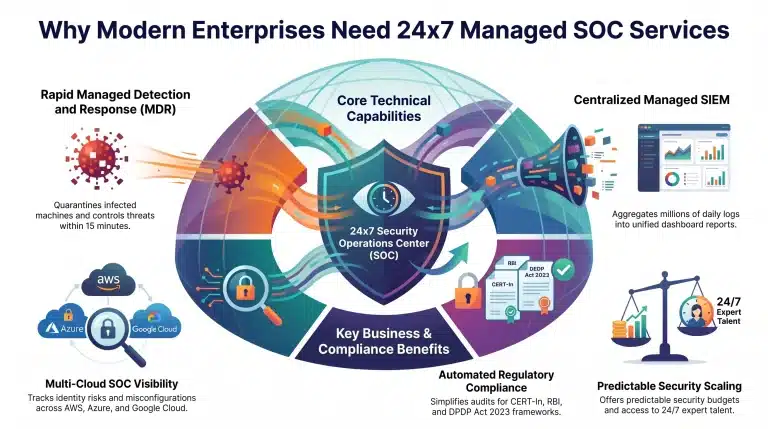
The conventional approach to IT monitoring is that of security logs. The MDR solution in India employs Endpoint Agent Telemetry, Network Analytics, and Threat Hunting Automation. As a result, it is possible for the security team to detect lateral movement, quarantine infected machines, and control threats within 15 minutes.
Cloud SOC as a Service in India
As Indian companies implement hybrid multi-cloud strategies using Amazon Web Services (AWS), Microsoft Azure, and Google Cloud, perimeter security will be inadequate. Cloud SOC solutions connect via API to track issues related to identity management, improperly configured cloud storage, and rogue servers.
Managed SIEM Services in India
Security information and event management (SIEM) tools process millions of security logs generated each day. Managed SIEM solutions bring all this data together on one easy-to-use dashboard, preventing alert fatigue and maintaining the audit trails needed for local governance.
Why Managed Detection and Response Improves Cybersecurity Outcomes
Managed Detection and Response (MDR) has become an integral part of SOC operations. Whereas traditional methods rely on generating large numbers of alerts, MDR is based on finding real threats and immediately reacting to them to prevent any further harm.
Through a combination of security analytics, human skills, and automatic response mechanisms, MDR allows for a quicker detection of ransomware infections, credential compromises, insider threats, and malicious network activities. Security analysts assess the behavior that might pose a threat, understand its impact on the business, and launch containment actions to prevent further penetration of the network by the threat actors.
Strengthening Cloud Security Through Continuous Monitoring
Organizations that are shifting their workloads to AWS, Microsoft Azure, and Google Cloud need cloud visibility as an absolute necessity when it comes to cybersecurity resilience. Conventional perimeter-centric security measures are not enough when it comes to securing the constantly changing environment of cloud computing.
Through the services of cloud SOC, organizations can have complete monitoring of all cloud resources, identities, applications, and configurations. This allows the organization to detect any attempts at unauthorized access, misuse of privileges, improperly configured storage services, and anomalous user activity.
Continuous cloud monitoring allows the organization to have better control over its digital assets.
Supporting Regulatory Compliance and Governance Requirements
There is an increasing need in cybersecurity laws for organizations to prove their capability in detecting, investigating, and responding to security incidents. The various regulatory frameworks include CERT-In, RBI cybersecurity framework, and the Digital Personal Data Protection (DPDP) law, which have increased the standards regarding security monitoring and incident management.
SOC-as-a-service solutions help in compliance efforts through logging, generating audit-compliant reports, documenting incidents, and offering continuous monitoring proof. The organizations can thus enhance their governance and make audits easier and manageable.
An organized SOC program does not only secure an organization, but it also helps in achieving better compliance standards.
Business Benefits of Partnering with a 24×7 Managed SOC Services Provider
Even though improved security is still the main aim, there are also other benefits that come from using managed SOC services. Companies will have access to specialized cybersecurity skills without the problem of recruiting security analysts. The security budgets of companies will become more predictable, and the teams can concentrate on other things rather than spend time looking at thousands of security alerts.
The constant monitoring of the managed SOC will contribute to better downtime reduction and faster incident response. While the company grows, it will be easier to increase the security scope without big expenses on new infrastructure and staff.
How To Choose the Best Managed SOC Services Provider In India
Choosing the correct SOC partner depends on assessing its technical and operational readiness. A good SOC partner will demonstrate the ability to provide efficient incident response procedures, sophisticated threat detection capabilities, knowledge of cloud security, compliance support services, and experienced security analysts working round the clock.
It should serve as an extension of the organization’s IT and security team and provide useful insights as well as proactive threat management.
Conclusion
Due to the increased sophistication of cyber-attacks, organizations need security operations that are not limited to conventional monitoring methods. A reliable 24×7 Managed SOC service provider is equipped with the technology, skills, and operations that help to detect and mitigate the attack in real-time.
Whether it be Managed Detection and Response, Cloud Security Monitoring, Compliance Management, or SIEM Management; SOC as a Service enables organizations to enhance their cybersecurity posture without needing to set up their own Security Operation Centers. For organizations that need constant protection and resilience, SOC as a Service is no longer an option but a requirement.
Strengthen Your Security Posture with 24×7 SOC Monitoring. Contact Us Today.
Need Managed SOC and SIEM Services for your 2026 project?
Get a free consultation with our tech team — no commitment.
Frequently Asked Questions
The provision of Managed SOC involves keeping complete audit logs, creating reports that are compliance-ready, capturing incident response, and maintaining continuous monitoring proofs required for compliance with the rigorous standards of incident reporting laid down by CERT-In, RBI, and the DPDP Act 2023.
Traditional log monitoring involves the generation of alerts from event logs, leading to alert fatigue. MDR involves using endpoint telemetry, network analysis, automation, and human skills to hunt for threats and isolate the infected devices.
Perimeter security solutions fail to provide protection for dynamic cloud architectures such as AWS, Azure, and Google Cloud. A Cloud SOC connects through APIs and monitors identities and access management, corrects any misconfiguration in cloud storage, identifies any access attempts by unauthorized persons, and monitors rogue servers.
Some of the important factors include technical and operational readiness in terms of 24x7 availability of skilled analysts, containment of incidents, and cloud security skills.