Choosing the right cloud infrastructure isn’t simply an IT-related issue anymore; it directly impacts cost, performance, security, and business scalability.
Yet many organizations struggle with one core question:
Should we use a private cloud or a public cloud?
The answer would depend upon your particular use of case, regulatory compliance requirements, and future growth considerations. Let us help you understand Private Cloud vs Public Cloud.
What is a private cloud?
A private cloud is one that uses a cloud computing solution for use by a single business organization. The private cloud may be installed on-premises or by a third-party, but it is always designed for exclusive use by the business organization alone. Such a cloud computing solution is preferred because of high governance and security measures.
The private cloud is highly favored by business organizations that require high-level governance and consistent performance. Business organizations employ technology solutions like VMware or OpenStack to create their own private clouds.
What is a public cloud?
Public cloud simply means any cloud offered through the Internet by an external cloud service provider. Some popular examples include AWS, Microsoft Azure, and Google Cloud; they offer shared infrastructure that can be accessed by multiple customers within a secure and safe environment. One reason behind the popularity of public clouds is that one has to pay for what they consume.
Public cloud comes in handy when there is a need for quick deployment of an application across a wide geographical area, and many managed cloud services are available. Public clouds save one from investing in hardware purchase and management.
Key difference between Private cloud vs. Public cloud
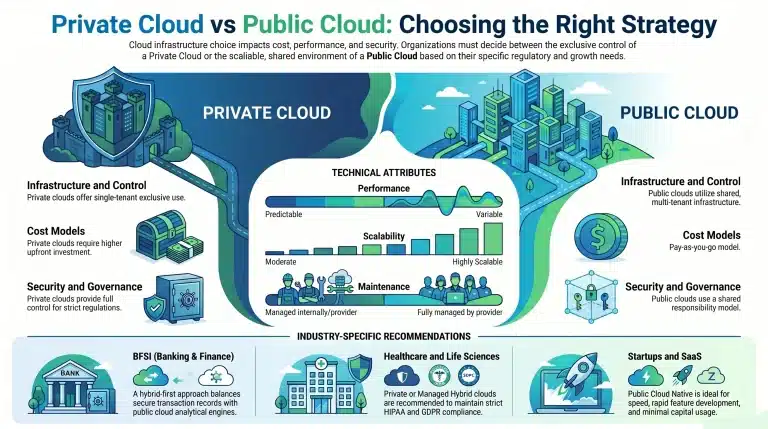
Private clouds enable higher customization and control, whereas public clouds can scale quickly and require less initial investment. The best fit will depend on your needs, but a good combination would be a hybrid solution. Here’s the quick answer for decision-makers:
| Feature | Private Cloud | Public Cloud |
| Infrastructure | Single-tenant | Multi-tenant |
| Security | High (full control) | Strong but shared responsibility |
| Cost | Higher upfront or fixed | Pay-as-you-go |
| Scalability | Moderate | Highly scalable |
| Performance | Predictable | Variable |
| Customization | Extensive | Limited |
| Compliance | Easier to meet strict regulations | Requires configuration |
| Maintenance | Managed internally or provider | Fully managed by provider |
Benefits of Private Cloud
Improved Security: The increased security provided by private clouds makes it ideal for organizations that need to adhere to stringent regulatory frameworks such as healthcare and financial institutions.
Customization: The organization gets the option of customizing the private cloud as per its requirements.
Performance: Private cloud does not provide any possibility of resource sharing, and this ensures predictable performance.
Data Protection: Confidential data can also be stored in the private cloud.
Benefits of Public Cloud
Cost Effectiveness: The public cloud helps save costs related to hardware acquisition, thus allowing businesses to utilize what they require.
Scalability: Public clouds offer flexibility to businesses as far as scalability is concerned, depending on the requirements of the business.
Global Presence: Public cloud service providers possess data centers throughout the globe, enabling companies to reach a global audience.
Management of Infrastructures: Service providers manage infrastructure management through continuous maintenance and updates.
Industry-Specific Architectural Recommendations
BFSI (Banking, Financial Services, & Insurance)
Recommendation: Implement a hybrid-first approach.
Reasoning: The ledger system, the transaction record, and the clearing process based on encryption will require running in a private cloud server or bare-metal server due to the requirement of regulatory compliance from organizations such as PCI-DSS and central banks. Yet, the customer interface for online banking, the analytical engine, and machine learning models for fraud detection can operate successfully in the public cloud environment.
Healthcare and Life Sciences
Recommendation: Private Cloud or Managed Hybrid Cloud.
Reasoning: EHRs and PHI must be maintained in a private cloud environment because of the requirement for strict data governance policies set forth in HIPPA and GDPR. Nodes on the public cloud may be used for medical research that is based on de-identified patient data or genetic sequence analysis.
Startups & Software-as-a-Service (SaaS)
Recommendation: Public Cloud Native.
Reasoning: The startup companies have to concentrate on speediness, rapid development of features, and minimal capital usage. Software build through the native method on the public cloud gives greater scope for pivoting and scalability of the infrastructure based on user volume.
Conclusion
Choosing between private and public cloud solutions is not a matter of picking the better solution; instead, it’s a matter of choosing which is more suited to the needs of your company. The use of public clouds will give you scalability and easy deployment capabilities if that is what your company requires. Meanwhile, if stability is required along with cost structures, then private clouds are your solution.
It is essential to know how to deploy, migrate, and optimize your cloud infrastructure, and for this, you will need professionals who are well versed in the process. IBN Tech has over 27 years of experience within the field of IT infrastructures such as AWS and Microsoft Azure, among others. We offer cloud services based on your needs, whether that means cutting down your public cloud expenses or designing a hybrid/private cloud infrastructure for your enterprise-level company.
Choosing the right cloud environment starts here. Book an appointment with IBN Tech today!
Need Cloud Service for your 2026 project?
Get a free consultation with our tech team — no commitment.
FAQs
- What is the difference between private and public cloud?
Private cloud is designed for a single enterprise, whereas public cloud is provided by an external party and accessed separately by customers in their individual domains.
- Is private cloud more secure than public cloud?
No, as the level of security greatly depends on how it is implemented; thus, the public cloud may also provide a high level of security.
- Is public cloud cheaper than private cloud?
Most likely yes, since its initial price is much lower, and it uses a subscription model. However, costs depend on other factors in the long run.
- Which cloud is better for compliance?
Private cloud will always be more convenient in meeting rigorous compliance requirements, but public cloud also allows compliance through proper design of policies, architectures, and controls.
- Should businesses choose hybrid cloud?
The most advantageous option in most cases is hybrid cloud. This is particularly important for industries that are subject to regulations, for migrating legacy environments, and for businesses that require flexibility and control.
- Which cloud is better for startups?
Startups should definitely go with public cloud due to ease of deployment, scalability, and lack of expensive infrastructural investments.