SOC 2 compliance is an important achievement for any SaaS, fintech or technology-based organization. Nonetheless, getting your audit done successfully depends on more than the quality of your internal controls; it all depends on whether you chose a good auditor. Working with the right SOC 2 auditor will simplify your audit process, while working with the wrong one might result in excessive delays and unexpected costs.
Before you enter into an engagement agreement with an auditor, there are certain aspects that should be considered apart from costs and timeline. Asking the right questions is a great way to identify a suitable partner for your SOC 2 audit.
Questions to Ask Before Choosing a SOC 2 Auditor
- Verify the Auditor’s Accreditation
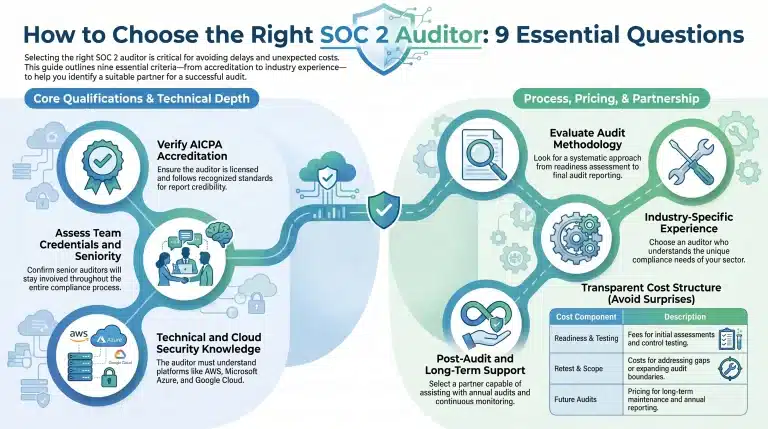
Your SOC 2 auditor must be a licensed professional who is authorized to do SOC 2 audits and produce their respective reports. The selection of an auditor who is associated with the American Institute of Certified Public Accountants assures you that the audit will be done using recognized standards in the industry, thus making sure that the report has enough credibility for your customers and investors.
- Evaluate Their SOC 2 Experience
The experience of the auditors is very important in conducting the audit for SOC 2. The auditor that has done many audits for SOC 2 will be more knowledgeable of the difficulties, tests, and expectations involved in the process.
Find out how other clients describe the auditing services of this auditor. This information will indicate the auditor’s capability in providing quality audit services.
- Assess Team Expertise and Credentials
Prior to choosing an auditor for SOC 2, spend some time assessing the credentials and experience of those individuals who will participate in the process of auditing. This will allow you to determine whether they are qualified to review your controls and compliance environment. Find out how many SOC 2 audits they have done, what credentials they hold, who will be overseeing the audit, and whether senior auditors will stay on board until the end of the process.
- Review Their Communication Approach
SOC 2 audits require constant coordination between your organization and the auditor. If interaction is not handled well, problems and stress may ensue.
Select an auditor who has clear communication skills, answers quickly, and presents compliance issues from a business perspective. Communication can greatly facilitate the audit process.
- Check Technical and Cloud Security Knowledge
Organizations in the modern world use various technologies which include cloud computing, SaaS products, DevOps software, identity management services, and cybersecurity services among others.
It is important that your auditor understands the technologies used by your organization and feels comfortable evaluating the controls in environments running on platforms like AWS, Microsoft Azure, and Google Cloud.
An auditor with technical knowledge will make the job of evaluation easier and more meaningful.
- Understand the Complete Cost Structure
Although price shouldn’t be the only thing to consider, knowing the total cost is important.
Request that they give you a breakdown of:
- Audit costs
- Readiness assessments
- Test costs
- Retest costs
- Extra scope costs
- Price of future audits
Being aware of pricing upfront can help avoid surprises in the future.
- Evaluate Their Audit Methodology
All SOC 2 auditors have a different process when auditing, which is why it is critical to be aware of how the auditor audits before you engage them. An effective auditor usually starts with the readiness assessment, where they assess the level of security that you have in place before performing a gap assessment. They then proceed to scope definition, gathering evidence, control testing, and finally, audit reporting. Those auditors that have a systematic process usually find it easier to manage the project without any hiccups.
- Look for Industry-Specific Experience
Each industry comes with its own set of operational and compliance needs. A fintech firm, a healthcare organization, a SaaS company, and a managed service provider will each have their own security issues.
With an auditor who is knowledgeable about your specific industry, you can expect to have more productive conversations and an easier audit process.
- Assess Post-Audit Support and Long-Term Partnership
Compliance with SOC 2 standards is not something that is achieved once and for all, but it is a continuous process. Once the audit is done, companies need to maintain the controls and monitor their security activities for the upcoming audits. So, it makes sense to select an auditor who will be able to help the company continuously in maintaining compliance, performing audits annually, recommending improvement of controls, and help in SOC 2 Type II audits in the future.
Final Thoughts
Selecting an ideal SOC 2 auditor is a process that has great potential of affecting the outcome of your compliance process. The right auditor must not only possess technical competence but must also have industry experience, be a good communicator, charge reasonable rates, and follow an organized audit approach. This is why it pays to ask these questions before engaging the services of an auditor.
Want to improve your security stance and comply with requirements? Get started with IBN Technologies.
Need SOC 2 Compliance Services for your 2026 project?
Get a free consultation with our tech team — no commitment.
FAQs
1. How Long Does a SOC 2 Audit Take?
The duration varies according to the nature of audit to be done. For instance, the SOC 2 Type I audit can take between 2 to 4 weeks since it focuses on controls on one date. The SOC 2 Type II audit, on the other hand, has to take a duration of 3 to 12 months to observe the operation of controls.
2. What Happens If a Control Failure Is Identified During the Audit?
In case of identification of any deficiency within the control process, it becomes an exception for the SOC 2 report. In a number of situations, there may be enough information available with the organization that will allow the problem to be sorted out. Minor exceptions generally do not make the entire SOC 2 report invalid.
3. What Is the Difference Between a SOC 2 Type I and Type II Report?
The SOC 2 Type I Report is used to determine whether the controls within the entity are properly designed at a particular time point. The SOC 2 Type II Report, on the other hand, takes the assessment process one step ahead where the effectiveness of the controls is evaluated over a defined period of time, normally from 3 to 12 months.