Cyber threats continue to grow in both scale and sophistication, putting businesses of every size at risk. From early-stage startups and SaaS providers to large financial institutions and e‑commerce brands, any organization relying on digital systems faces constant exposure to cyberattacks. As threat actors evolve their techniques, a reactive security approach is no longer enough.
This is where VAPT Testing becomes essential, helping organizations proactively identify weaknesses, validate real-world attack scenarios, and significantly reduce the likelihood of costly security breaches before they happen.
Understanding VAPT Testing
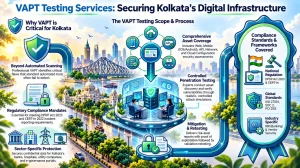
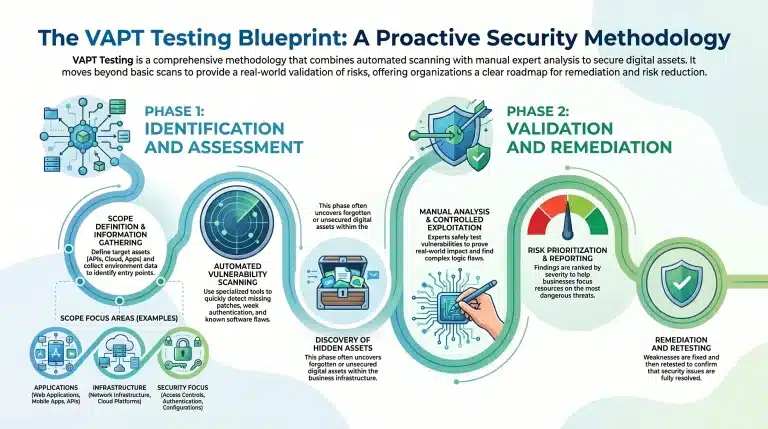
VAPT Testing identifies and validates security vulnerabilities across digital assets by combining vulnerability assessment with penetration testing. It not only finds weaknesses but also tests how they could be exploited in real-world attacks.
Unlike basic scans, VAPT highlights real business risks, helping organizations focus on the most critical fixes and improve overall security.
Scope Definition
Every successful VAPT engagement begins with scope definition. In this stage, the business and the testing team decide which assets will be included in the assessment, what methods will be used, and what limits apply during testing. The scope may cover web applications, mobile apps, APIs, cloud platforms, network infrastructure, or a combination of these.
This step is important because it ensures the assessment is relevant to the business and aligned with its actual attack surface. A clear scope also prevents confusion later in the process and helps the results stay focused and actionable. Without this foundation, even a strong test can lose value.
Information Gathering
Once the scope is defined, the next step is information gathering. Here, testers collect details about the target environment, including domains, subdomains, IPs, technologies, services, and exposed assets. This helps them understand how the environment is structured and where the possible entry points may exist.
This phase often uncovers hidden or forgotten assets that may not be fully secured. It also gives testers the context they need before moving into deeper analysis. Strong information gathering can make the difference between a surface-level assessment and a meaningful security review.
Vulnerability Scanning
After gathering information, the testing team begins vulnerability scanning. This step uses specialized tools to detect common weaknesses such as missing patches, insecure configurations, weak authentication controls, exposed services, and known software flaws. Scanning helps identify a wide range of issues quickly and gives the team a starting point for deeper investigation.
However, automated scanning alone is not enough. Tools may miss subtle problems or produce false positives, which is why the results always need human review. In VAPT Testing, scanning is only one part of the larger process, not the final answer.
Manual Analysis
Manual analysis is where expert testers review scan findings and inspect the environment in more detail. They look for business logic flaws, insecure access controls, chained vulnerabilities, and attack paths that automated tools may not detect. This is one of the most important parts of the process because many serious security issues only become visible through expert judgment.
Manual testing also helps separate theoretical findings from real risks. A weakness may appear minor in a report, but manual review can show whether it can actually be used in an attack. That kind of analysis gives businesses a far more accurate picture of their security posture.
Controlled Exploitation
Once vulnerabilities are confirmed, penetration testers move into controlled exploitation. This means they safely test whether a weakness can be used to access data, bypass authentication, escalate privileges, or disrupt services. The goal is not to damage systems, but to prove how serious the issue could be if a real attacker found it.
This stage is what makes VAPT especially valuable. It shows not only that a vulnerability exists, but also what its practical impact might be. For business leaders and security teams, that evidence makes it easier to understand the urgency of the issue.
Risk Prioritization
After testing is complete, the findings are reviewed and ranked by severity. Not every vulnerability carries the same level of risk, so prioritization helps businesses focus on what matters most. Some issues may be easy to fix, while others may expose sensitive data or critical infrastructure.
A strong VAPT process considers both technical severity and business impact. This allows organizations to put their resources toward the most dangerous vulnerabilities first. Prioritization is one of the reasons VAPT is more useful than a simple checklist of issues.
Reporting and Recommendations
The final stage is reporting. A good VAPT report should explain what was tested, what vulnerabilities were found, how they were validated, and what the business should do next. It should also include severity ratings, supporting evidence, and practical remediation steps that technical and non-technical stakeholders can understand.
This report is more than documentation. It becomes a roadmap for security improvement. When done well, it helps businesses turn assessment results into meaningful action.
Remediation and Retesting
VAPT does not end when the report is delivered. The next step is remediation, where the organization fixes the vulnerabilities identified during the assessment. In many cases, retesting is also performed after the fixes are applied to confirm that the issues have been properly resolved.
This final step is essential because security improves only when weaknesses are actually addressed. Retesting also gives businesses confidence that their efforts have had the intended effect. It closes the loop and makes the entire VAPT process more valuable.
Why the Process Matters
The step-by-step VAPT methodology gives businesses a practical way to understand and reduce cyber risk. It helps teams move from uncertainty to clarity by showing where weaknesses exist, how serious they are, and what should be fixed first. That makes it highly useful for organizations of all sizes and across all industries.
For businesses that handle customer data, online transactions, cloud infrastructure, or connected applications, this level of visibility is no longer optional. It is a core part of maintaining trust, reducing risk, and staying ahead of attackers.
Conclusion
VAPT Testing helps organizations identify vulnerabilities, validate real attack exposure, and strengthen security through a structured, step-by-step process. By combining vulnerability assessment with penetration testing, businesses gain a more accurate view of their risk and a clearer path toward remediation. For companies looking for dependable vapt services in india or a trusted vapt service provider with global delivery capability, IBN Technologies stands out as a reliable partner for security-focused testing, clear reporting, and remediation-driven support.
Need VAPT service for your 2026 project?
Get a free consultation with our engineering team — no commitment.
FAQs
Q.1 Why is vulnerability scanning alone not sufficient?
Automated scanning tools may miss subtle problems or produce false positives. Human review is always necessary to validate findings and uncover issues that tools cannot detect on their own.
Q2. What should a good VAPT report include?
A: A good VAPT report should include what was tested, vulnerabilities found, how they were validated, severity ratings, supporting evidence, and practical remediation steps understandable by both technical and non-technical stakeholders.
Q3. How is VAPT different from traditional security testing?
A: Unlike traditional security testing that may only scan for known issues, VAPT combines automated scanning with manual expert analysis and real attack simulation, providing a far more accurate and comprehensive view of security risks.