Relying on periodic, point-in-time security testing is like auditing a business only once a year while ignoring its daily cash flow. In fast-changing enterprise environments, this approach quickly becomes ineffective, as new APIs are deployed, cloud resources expand, and thousands of new vulnerabilities are disclosed each year, constantly reshaping the attack surface.
This creates a critical security gap for organizations trying to protect dynamic systems. To address this, companies are shifting toward Continuous Vulnerability Management (CVM), leveraging managed vulnerability scanning services to adapt in real time and move from reactive patching to proactive, ongoing protection.
What is Continuous Vulnerability Scanning Services ?
Continuous vulnerability scanning refers to the automated process of detecting vulnerabilities, misconfigurations, and outdated software versions on a consistent basis in real-time within your IT infrastructure.
Unlike traditional scanning, continuous monitoring has been designed within your network and cloud environment and DevSecOps pipelines.
How Continuous Scanning Works
Continuous scanning replaces scheduled scans by employing event-driven and automated discovery processes including:
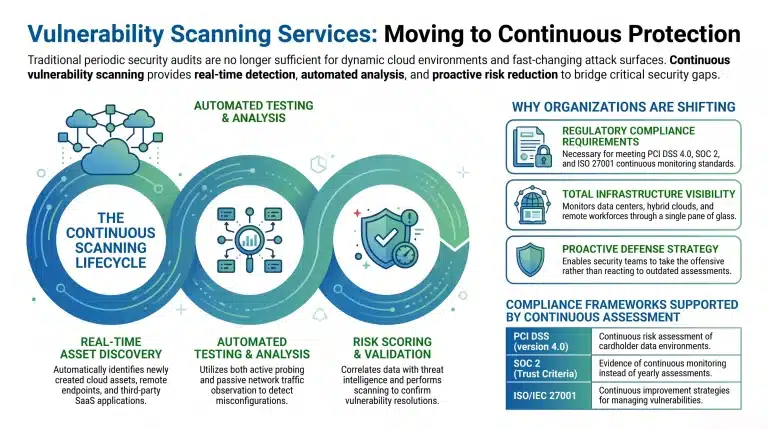
1.Asset Discovery: Gain real-time knowledge of your entire digital footprint by automatically discovering newly created cloud assets, remote endpoints, and third-party SaaS applications.
- 2.Automated Testing & Analysis:Automated probing through the use of active and passive scanning techniques. Active scanning involves actively probing the port status and configuration of the asset while passive scanning involves passively observing the network traffic.
- Real-Time Risk Scoring:Rather than flooding your IT team with hundreds of generic alerts, continuous scanners correlate data with threat intelligence and criticality of an asset to determine what requires immediate action.
- Remediation Validation:After implementing patches or mitigating controls, a scanner performs another round of scanning to confirm the resolution of the vulnerability.
Compliance Requirements: Going Beyond the Audit Check-List
Alongside the basic risk-mitigation aspect, continuous vulnerability assessment has quickly moved beyond being a best practice to becoming an absolute requirement by regulatory bodies. The following compliance schemes clearly do not subscribe to a point-in-time approach:
- PCI DSS (version 4.0): Requires rigorous and continuous risk assessment and management of vulnerabilities of cardholder data environments.
- SOC 2 (Trust Services Criteria): Requires evidence of continuous monitoring and risk mitigation in place of localized yearly assessments.
- ISO/IEC 27001: Requires continuous improvement strategies for managing vulnerabilities.
Leveraging a managed service means you have a concrete paper trail of due diligence and operational resilience.
Choosing the Right Vulnerability Scanning Service
When expanding your vulnerability management program, you have to choose the best suited platform or MSSP that provides total visibility into your security requirements. Some of the important criteria for this include:
- Visibility: A feature that helps you to monitor your data centers, hybrid clouds, web applications, and endpoints of the remote workforce through one single pane of glass.
- DevSecOps: Integration with CI/CD pipeline that detects and resolves application vulnerabilities before they reach production.
- Risk-based context: Threat intelligence from trusted organizations like CISA and NIST that enables you to prioritize vulnerabilities.
IBN Technologies will help you fulfill all the requirements through Vulnerability Management Services, which comprise of ongoing monitoring, expert assessments and remediation of vulnerabilities.
Final Thoughts
The threat landscape changes quickly, but so can your vulnerability management process. Transitioning from a reactive, planned assessment process to a continuous approach enables your security team to go from catching up to taking the offensive when it comes to securing your operations.
Deploying a continuous vulnerability scanning solution is the best action you can take to address any vulnerabilities within your enterprise and greatly reduce your risk exposure.
Need VAPT Services for your 2026 project?
Get a free consultation with our tech team — no commitment.
FAQs
How does vulnerability assessment differ from vulnerability scanning?
Vulnerability scanning refers to software used to check the networks and computer systems for vulnerabilities. The vulnerabilities can be in form of bugs, open ports, or weaknesses in the configuration of systems. Vulnerability assessment refers to a more extensive process where the results from scanning are analyzed and a remediation strategy is developed.
How often should an enterprise run vulnerability scans?
Although the compliance regulations (e.g., PCI DSS or SOC 2) used to require quarterly or monthly scans, current best practices in enterprise-level companies call for continuous scanning. All high-risk internet-exposed resources and cloud-based infrastructure need to be scanned daily or on-demand during any deployments of new code.
What is the difference between vulnerability scanning and penetration testing?
Vulnerability Scanning refers to the automatic process which aims to detect many different weaknesses through an analysis of the surface. On the other hand, Penetration Testing is the in-depth process of trying to exploit the weaknesses detected via the vulnerabilities scanning process.