In a time where cyber-attacks have resulted in a loss of billions of dollars for companies each year, it is critical to prove that you provide a secure environment for your business operations. The SOC 2 audit is preferred approach that service organizations use when seeking to reassure their customers that they protect their data.
What Is a SOC 2 Audit?
The SOC 2 compliance audit involves the independent assessment of controls within the service organization with respect to AICPA’s trust services criteria. As opposed to self-certification, this type of audit involves external auditors to evaluate the controls at your organization in accordance with SSAE No. 18 (AT-C 105).
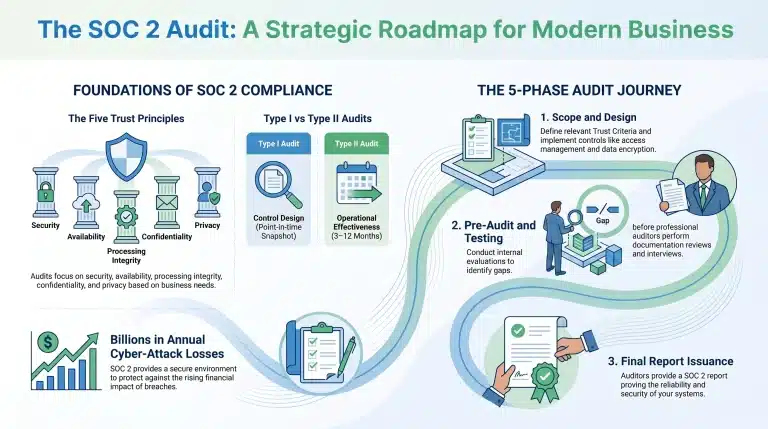
The audit focuses on five trust principles: security, availability, processing integrity, confidentiality, and privacy. An organization chooses the criteria that it will cover according to its business model and needs. The most common approach is to cover only security initially because it is essential for all the other criteria.
Why Your Organization Needs a SOC 2 Audit
Building Client Confidence
SOC 2 certification has become an essential criterion for companies assessing Saas service providers and cloud vendors. The audit serves as proof that you have what it takes to handle customer data responsibly, thus turning security into a competitive edge.
Competitive Differentiation
SOC 2 certification distinguishes between companies adhering to the prescribed standards and those failing to adhere to the same within competitive environments. It provides you with the necessary data about how you manage your data.
Risk Reduction
The audit process finds security weaknesses before any incident occurs. By ensuring that controls provide the appropriate management of information security, cybersecurity risk is minimized within an organization.
Executive Accountability
Interestingly, SOC 2 requires testing the Board of Directors’ oversight of internal controls.
Types of SOC 2 Audits
Type I: Design Assessment
SOC 2 Type I audit checks if your internal controls have been properly designed for compliance with relevant trust services principles at a particular period. In other words, it is a snapshot test that assesses the capability of your systems.
Type II: Operational Effectiveness
The SOC 2 Type II audit is more elaborate as it determines whether controls have been working properly for a period of three to twelve months. This type of audit ensures operational effectiveness, rather than just adequate design.
The SOC 2 Audit Process
Phase 1: Preparation and Scope Definition
The first thing that needs to be done is figuring out which of the criteria from the Trust Services Framework will be evaluated. It will impact the complexity, cost and duration of the evaluation process. Consider your business model, customer needs and any legal requirements.
Phase 2: Control Design and Implementation
Implement controls covering the criteria you selected earlier. Critical categories are access management, data encryption, monitoring, incident response procedures, vendor risk management, and change management. Proper documentation is crucial as it causes most audits to fail.
Phase 3: Pre-Audit Evaluation
Conduct an evaluation of your controls, procedures, and documentation prior to engaging professional auditors. The purpose is to identify any gaps in advance and avoid unnecessary changes when auditors start doing their work.
Phase 4: External Audit
Professional certified auditors evaluate your compliance with the Trust Services Criteria using the systems and processes at your organization. Auditors review documentation, conduct interviews, and test controls.
Phase 5: Report Creation
The auditor provides your SOC 2 report regarding your control framework and audit findings after all the auditing process is completed. The SOC 2 report will help in proving the reliability of your processes and systems.
Conclusion
The SOC 2 audit is not only about fulfilling regulatory requirements, but an important step towards confirming that your company is capable of protecting client information and ensuring secure practices. SOC 2 compliance will help you create a competitive advantage for your business.
To achieve SOC 2 compliance and ensure its continuous maintenance, certain steps need to be taken. These include preparing ahead of time and collaborating with the right partners such as IBN Technologies in order to ease the path towards success.
The question isn’t whether your organization can afford a SOC 2 audit. The question is whether your B2B growth strategy can afford to skip it. Partner with IBN Tech to make SOC 2 certification a competitive advantage, not just a compliance requirement.
Need SOC 2 Compliance Services for your 2026 project?
Get a free consultation with our tech team — no commitment.
Frequently Asked Questions
Type I checks if your security controls are properly designed at a single point in time. Type II tests if those controls actually operated effectively over a 3 to 12-month period.
It typically takes 3 to 12 months total. Preparation and fixing security gaps takes 2 to 4 months, followed by the mandatory monitoring window required for a Type II report.
No. Only Security is mandatory. You should only add Availability, Confidentiality, Processing Integrity, or Privacy if your business model or client contracts specifically require them.