Most businesses spend highly in cybersecurity tools firewalls, antivirus software, endpoint protection, and multi-factor authentication. Yet headlines about ransomware attacks and data breaches remain to top on the news. Why? Because having security tools isn’t the same as knowing they’ll work as someone forcefully attempts to break in.
Instead of believing your defenses are strong, Black Box Penetration Testing puts your security to the test in real-world conditions, helping you find vulnerabilities, confirm defenses, and see how secure your business truly is before hackers do.
What Is Black Box Penetration Testing?
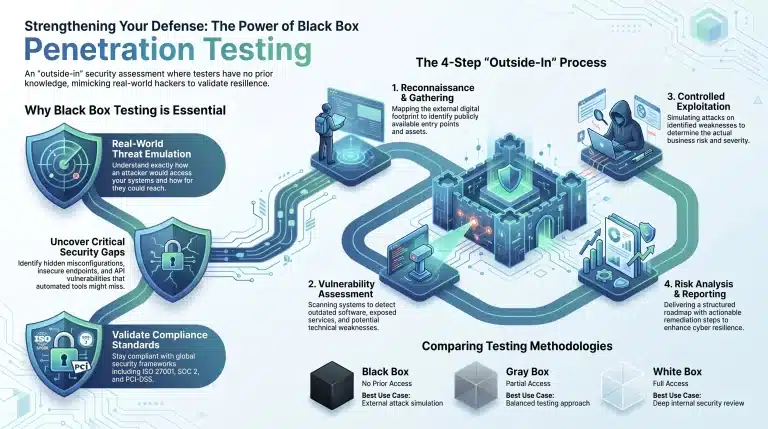
Black Box Penetration Testing is an advanced cyber security service that involves hacking into your system without any foreknowledge, just like actual hackers would do. Without knowing anything about the source code or the inner workings of your system, the testers will use only the publicly available information to find the vulnerabilities and entry points.
The “outside in” strategy is the closest thing to an actual attack situation, allowing for a completely objective look at your security from outside the system. This allows you to find the weaknesses and confirm the effectiveness of your security.
Why Black Box Penetration Testing Is Essential
Black box testing is an innovative security method in that it tests your system using the same scenario as a hacker. In other words, this method doesn’t rely on assumptions; instead, it puts your system under test without any prior information about your system.
Using black box testing, organizations can:
- Threat Emulation
Understand how attackers will try to access your systems and what extent they would be able to reach in case of vulnerabilities.
- Outside-In Security Assessment
Get an accurate assessment from an external point of view without any internal bias.
- Security Gap Assessment
Uncover your biggest security gaps, including misconfigurations, insecure endpoints, and API security issues.
- Data Security Plan
Protect yourself from data breaches that could cost you money and harm your relationship with customers.
- Security Compliance
Stay compliant with standards like ISO 27001, SOC 2, and PCI-DSS through validated security testing.
How Black Box Penetration Testing Works
In Black Box Penetration Testing, the process attempts to simulate the actions of attackers against an organization for gaining valuable information. This process is conducted in each phase in order to identify the vulnerabilities and come up with practical solutions.
- Reconnaissance & Information Gathering
The process starts with collecting information on publicly available resources in order to identify the company’s external digital footprint. It allows for discovering any vulnerable assets, domains, and access points.
Outcome: Clear visibility into what external threats can discover and exploit.
- Vulnerability Assessment
Several scanning technologies have been developed to detect such weaknesses as misconfigurations, outdated software versions, and exposed services in the systems and applications.
Outcome: A comprehensive list of potential vulnerabilities that require attention.
- Controlled Exploitation
Identified vulnerabilities are tested through attack simulation, which will determine the actual impact they have in the physical world. Through such tests, it is possible to establish just how far an attacker may go in exploiting these vulnerabilities.
Outcome: A realistic understanding of risk severity and potential business impact.
- Risk Analysis & Actionable Reporting
All the findings have been documented in a report that includes all the weaknesses and what needs to be done for the solution. Speedy action is the priority.
Outcome: A structured roadmap to reduce risks and enhance cyber resilience.
Black Box vs Other Testing Approaches
| Testing Type | Access Level | Best Use Case |
| Black Box | No prior access | External attack simulation |
| White Box | Full access | Deep internal security review |
| Gray Box | Partial access | Balanced testing approach |
Choosing the Right Pentesting Partner
Choosing the right Black Box Penetration Testing service provider is important in order to get relevant actionable results other than just a standard list of potential vulnerabilities. Testing efficiency greatly depends on the quality and type of the service provider.
A good service provider must have:
- Great proficiency in all types of attacks, such as attacks on web applications, clouds, APIs, and networks
- A well-balanced testing approach combining automation and manual testing for speed and precision
- Business-oriented reporting and remediation steps and not just the list of technical issues
- A compliance-driven testing framework according to ISO 27001, SOC 2, PCI-DSS, etc.
- Continual testing options rather than a single testing session
The providers offering comprehensive security services and providing domain expertise and relevant results allow businesses to go further and develop proactive cybersecurity strategies.
The right cybersecurity service provider helps reduce risks and increase resilience of the system.
Conclusion
Cyber attackers are constantly finding new ways to exploit external vulnerabilities, often bypassing traditional defenses. Black Box Penetration Testing helps to create the link between the assumed security level of a system and the level that has been tested for its performance under attack conditions.
With the right strategies and by partnering with IBN Technologies, a trusted provider of penetration testing services, organizations can strengthen their defenses, maintain compliance, and enhance their overall security posture.
Looking to validate your security posture? Connect with IBN Technologies to take a proactive step toward stronger, smarter security.
Need Penetration Testing for your 2026 project?
Get a free consultation with our Tech team — no commitment.
FAQs
- 1. Can black box testing cause system downtime or disrupt our business?
No, as it is a managed exploitation. The professional testing companies have set their strict “Rules of Engagement” before conducting a vulnerability test that will be conducted without compromising production servers and business continuity.
- 2. What specific security gaps does an external black box test uncover?
Mainly your footprint online. It is about the vulnerable misconfigured public software, old technology stacks, open endpoints, exposed APIs, and perimeter walls that could be hacked by a person on the internet.
- 3. How often should our business conduct black box penetration testing?
Once a year, at least for SOC 2 and PCI-DSS compliance. But it is strongly advised every time there are significant updates of the system, moving to the cloud, etc.