Businesses must implement robust security measures to safeguard valuable data and vital infrastructure as cyberattacks become more common and sophisticated. By providing ongoing monitoring, quick threat identification, and prompt reaction to incidents, SOC services help businesses lower risk and preserve operational resiliency.
Recently, Gartner predicts that in 2025, “60% of enterprises will consider cybersecurity risk an important criterion in third-party governance decisions. The annual cost of cybercrime is rising, and the threat of the environment is changing. Small and medium enterprises have emerged as prime targets for cyber-attacks, underscoring the importance of SOC services in ensuring security.
What Are SOC Services?
The SOC service is the core cybersecurity operations that protect the network, system, and critical data of an organization through continual monitoring, detection, analysis, and response to security threats.
These services are designed to offer organized response to incidents, to effectively detect and mitigate risks in real time, and to use advanced threat information to address vulnerabilities and new threats. Many firms can receive these capabilities with minimal hassle of keeping an internal staff by partnering with a reputable SOC provider.
Business Benefits of SOC Services
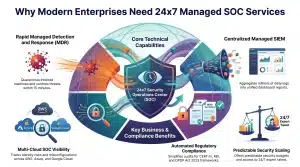
Outsourcing SOC security services provides several important benefits for businesses. First, it enables proactive threat detection and quick response, so security issues are found and resolved before hackers can cause serious damage. With 24/7 SOC monitoring, threats are identified at any time, even outside normal business hours, ensuring constant protection.
Second, SOC services assist companies in adhering to laws like HIPAA, GDPR, and PCI-DSS. By adhering to these guidelines, businesses may avoid penalties and legal issues and be confident that they are complying with all applicable security and privacy regulations.
Lastly, outsourcing SOC services promotes efficient corporate operations and is affordable. It keeps systems uninterrupted and lessens the need to recruit and train internal security personnel. This guarantees that the company can continue to run securely and effectively, avoids downtime, and safeguards income.
Why SOC Services Are Essential for Modern Businesses
The range of cyber threats is increasingly complex in nature for any organization in modern times. SOC services provide continuous monitoring to identify and mitigate such risks before they escalate further. Accordingly, organizations can enhance their cybersecurity posture by using advanced technology along with threat information to ensure operational continuity.
SOCs provide timely and efficient responses in addition to proactive threat detection. Competent analysts reduce downtime and prevent data loss by quickly locating, containing, and fixing problems. Following regulatory regulations like GDPR, HIPAA, and PCI-DSS protects customer data and company assets.
By providing access to specialist knowledge without the cost of hiring internal workers, SOC services increase a company’s resiliency. SOC as a service provider is a crucial component of any successful cybersecurity strategy since they protect critical systems, maintain data integrity, and maintain trust with stakeholders.
SOC Services vs. Traditional Security Measures
Unlike traditional security approaches, SOC services offer:
- Proactive Threat Detection:Ongoing surveillance finds dangers before they do harm.• Real-Time Response: Possible impacts are reduced by prompt mitigation.• Complete Visibility: Network, endpoint, and cloud environments are all monitored centrally. • Scalable Security Operations: Provides managed SOC solutions that are suited to organizational requirements and readily adjusts to company expansion and changing IT architecture.
How SOC Services Combat Sophisticated Cyber Attacks
SOC services act as the frontline defense against evolving cyber threats by combining real-time monitoring, intelligence, and advanced analytics to protect critical assets:
- Advanced Persistent Threats (APT):To find covert incursions, use threat intelligence, proactive danger hunting, and User and Entity Behavior Analytics (UEBA).• Ransomware: Automated quarantine and ongoing monitoring reduce impact and swiftly isolate compromised systems.• Phishing & Social Engineering: Stealing credentials is less likely thanks to AI-driven detection and behavior analytics. • Zero-day Exploits: By identifying and mitigating risks before updates become available, forensic evaluation and artificial intelligence anomaly detection improve the overall cybersecurity posture of SOC.
Why Businesses Trust IBN Tech for SOC Services
Businesses rely on IBN Technologies for SOC services including advanced threat recognition, 24-hour inspection, and prompt reaction to emergencies to keep critical systems secure and functional. Our skilled cybersecurity experts constantly protect digital records using innovative techniques and expertise.
IBN Tech delivers customized, scalable SOC solutions to satisfy the specific infrastructure and legal needs of any business. We help firms operate with confidence while managing growing cyber dangers by providing real-time analytics, clear reporting, and a focus on regulatory duties.
Join IBN Technologies now to deploy expert-led SOC services and create a robust, future-ready cybersecurity framework that safeguards your company around-the-clock.
FAQ’s
-
What is a SOC service?
A Security Operations Center (SOC) service is referred to as a SOC service. Organizations use this cybersecurity service to keep an eye on, identify, react to, and stop security threats in real time. In essence, it’s a specialized group or system that monitors your IT environment to guard against cyberattacks.
-
What does SOC stand for?
SOC commonly means: a Security Operations Center (cybersecurity team), System on Chip (all-in-one computer chip), or Service Organization Control (audit report on controls).
-
What is SOC used for?
SOC safeguards an organization’s IT infrastructure by constantly monitoring networks, servers, and endpoints for threats, promptly detecting and resolving cyberattacks, comprehensively reviewing security incidents, and ensuring adherence to corporate and governmental security standards.