Businesses are under pressure to offer features more quickly while maintaining strong application safety in today’s quickly changing software development world. Conventional security strategies, which prioritize security at the end of the production cycle, are no longer useful. DevSecOps automation is a contemporary method that integrates security into each stage of the Software Development Life Cycle (SDLC), allowing teams to strike a balance between defense, excellence, and performance.
Organizations may decrease complexity and remove silos through rendering security a common duty throughout growth, operational, and security departments. By ensuring that vulnerabilities are found early on, automatic security procedures enable teams to produce dependable and safe products without impeding creativity.
What is DevSecOps Automation?
Direct incorporation into security procedures, assessment, and enforcing methods into creation and implementation workflows is known as DevSecOps automation. Across the SDLC, automated tools continually check code, settings, and equipment rather than depending on human inspections.
This method guarantees that security needs are fulfilled from design to production, lowers mistakes made by humans, and increases predictability. Continuous input is made possible via automation, which helps developers address problems early and uphold strict software safety requirements.
Why Automate Security in DevOps?
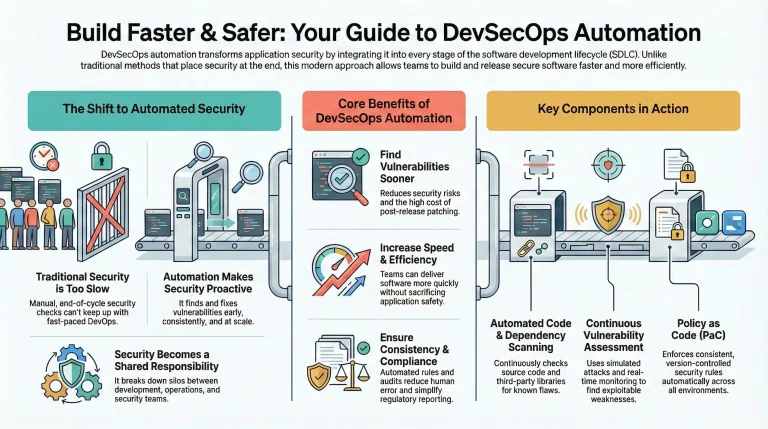
Conventional security procedures are unable to keep up with DevOps systems that move quickly. The automation of security guarantees that privacy is not jeopardized by fast progress. Vulnerabilities are found early, reliably, and widely by incorporating security into the CI/CD process.
Automation makes cybersecurity proactively compared to reactive by lowering errors made by people, enforcing compliance, and enabling ongoing monitoring. This guarantees that both established squads and DevSecOps startups maintain agility while maintaining the security and dependability of their applications.
Key Benefits of DevSecOps Automation
DevSecOps automation enhances the software development lifecycle by incorporating security into innovation and marketing techniques. It reduces security risks and after-release patch costs by enabling early detection of vulnerabilities. By leveraging security code, businesses can enforce predictable, consistent, and version-controlled safety requirements across all work.
By lowering human mistakes and harmonizing security tests throughout CI/CD pipelines, automation increases consistency and dependability. Teams can produce software more quickly without sacrificing security thanks to this integrated methodology. By successfully protecting cloud infrastructures, microservices, and intricate software systems, DevSecOps also promotes scalability.
Continuous monitoring guarantees immediate time threat recognition and prompt response to emerging threats. Robotic inspections of compliance simplify regulatory compliance and reduce audit effort. If everything is considered, DevSecOps automation increases operational efficiency, lowers costs, and enhances both the safety and overall performance of modern software platforms.
Core Components of DevSecOps Automation
1.Verification of Code and Artifact Security
- Source Code Review: Identifies flaws early on, enabling developers to fix problems prior to release.
- Library and Dependency Analysis: Verifies license adherence and looks for flaws in outside items.
- Compiled Code and Container Inspection: Examines transportable elements, files, and container pictures for any security flaws.
2. Ongoing Vulnerability Assessment
- Simulated Attack Testing: Assesses real-world apps to find vulnerabilities that may be exploited.
- Behavioral Monitoring: This technique tracks the behavior of apps in real-time to identify security flaws as they arise.
- Repository and Configuration Review: Identifies hazardous library settings, disclosed secrets, and errors in configurations.3.Identification and Handling of Secrets
- Use technologies like cloud secret management to automatically detect confidential data in code and enforce safe storage. 4. 44.Enforcing Policies as Code
- Reduces human mistakes and ensures consistency by implementing automated security rules in all contexts.
5.Automation of Compliance and Audits
- Simplifies audit processes and generates reports to guarantee regulatory compliance with standards like SOC 2 or ISO 27001, offering an end-to-end DevSecOps solution.
Top DevSecOps Automation Tools in 2026
Choosing the appropriate tools that facilitate testing for safety, evaluations of vulnerabilities, and adherence throughout the SDLC is essential to effective DevSecOps automation. Common tools consist of:
- Burp Suite – Dynamic assessment and testing ensure the safety of web applications.
- Nessus – Monitoring hosts as well as networks for vulnerabilities.
- Nmap – Port examination and network exploration.
- SQLMap – Finds and exploits SQL injection vulnerabilities automatically.
- Frida – Runtime analysis using a dynamic instrumentation toolbox.
- SonarQube – Stochastic applications security testing (SAST) for vulnerabilities and the quality of code.
- ManageEngine – IT administration and networking and endpoint safety automation.
- Qualys – Cloud security platforms, compliance, and managing vulnerabilities.
- Kali Linux – OS penetration testing using a variety of security instruments.
- DirBuster – Forceful file and directory finding on the web.
- Nikto – Using a web server scanner to find vulnerabilities.
How Can You Automate DevSecOps with IBN Technologies
Businesses wishing to execute DevSecOps automation may benefit from our methodical approach, which starts with a thorough evaluation of current workflows and security vulnerabilities. To guarantee early and ongoing risk identification, CI/CD procedures use automated SAST, DAST, and Software Composition Analysis (SCA).
After implementation, secure settings are enforced by code that enforces policies, and compliance is made easier by automatic audit reporting. IBN Technologies’ scalability frameworks and demonstrated skills allow businesses to collaborate with reliable devsecops vendors and deploy end-to-end devsecops services that provide quicker releases, more robust security, and sustained operational durability.
Conclusion
DevSecOps automation is essential in 2026 for quickly developing secure apps. Businesses may identify issues early, lower vulnerability, and deliver software more quickly without sacrificing reliability by integrating automating security and compliance across the SDLC. IBN Technologies helps companies deploy end-to-end DevSecOps automation that improves protection, guarantees compliance, and produces dependable, scalable systems thanks to its demonstrated experience.
FAQs
- What isDevSecOps automation?
DevSecOps automation is the practice of integrating security into the software development lifecycle through automated tools and processes, ensuring continuous protection, compliance, and secure delivery without slowing down development.
- What is automation in DevOps?
Automation in DevOps is the use of tools and scripts to streamline and perform repetitive tasks—such as building, testing, deploying, and monitoring—automatically, enabling faster, more reliable, and error-free software delivery.
- What are the 7 phases of DevOps?
The 7 phases of DevOps form a continuous cycle for efficient software delivery. They include Planning to set goals, Coding to develop the application, building to compile the code, testing to ensure quality, Release to prepare deployment, deploy to deliver to production, and monitor to track performance and security for ongoing improvement.