Businesses from all sectors are using managed soc services to improve cyber resilience and guarantee business continuity as cyber threats become more frequent and sophisticated. By providing ongoing surveillance of safety, sophisticated threat detection, and quick response to emergencies, these services help companies aggressively safeguard valuable data and vital systems.
Managed SOC services offer security at an enterprise level to small and medium-sized businesses (SMEs) without the cost and effort of developing an internal SOC. In an ever-changing attack landscape, large companies benefit from increased visibility, expansion, and effectiveness in operations that enable a mature and legally compliant safety strategy.
What is a Managed SOC?
A Managed Security Operations Center (Managed SOC) is an outsourced, centralized security service that continuously monitors cloud environments, networks, endpoints, and overall IT infrastructure. Acting as a SOC-as-a-Service provider, it delivers round‑the‑clock surveillance using skilled cybersecurity professionals and advanced detection technologies to identify and respond to emerging threats.
Organizations can lower cyber risk and increase security maturity while not significantly depending on internal assets in order by using proactive threat detection, automated alarms, and ongoing analysis.
The Shift from Traditional SOCs to Managed SOC Services
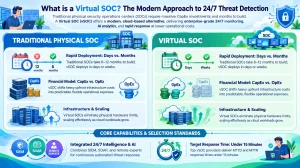
The combination of high operating expenses, a lack of qualified cybersecurity experts, inadequate monitoring coverage, and the quick evolution of cyber threats, traditional, in-house SOCs are becoming harder to operate. Because of this, a lot of businesses are switching to managed soc solutions, which provide more flexibility and lower costs.
Internal IT teams may concentrate on strategic objectives while security activities are completely safeguarded thanks to these contemporary services, which offer uninterrupted coverage, possession of specialized knowledge, and regularly updated technologies.
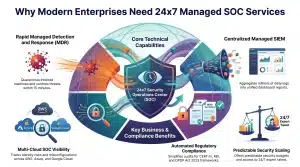
Core Capabilities of a Managed SOC
Managed SOC services deliver end-of-the-end security coverage through the following key components:
- Endpoint Security:Anti-malware software, update management, and endpoint protection and response (EDR) are used to continuouslymonitor laptops, servers, and portable computers in order to detect and respond to threats in real time.• Network security: To monitor traffic, identify anomalies, and prevent unauthorized access, antivirus software, secure VPNs, Internet Detection and Response (NDR), and malware detection and Management Systems (IDS/IPS) are established.• Cloud Application Security: In SaaS, IaaS, and PaaS settings, cloud applications and their workloads are protected through the use of Cloud Access Security Brokers (CASB), authentication and access management (IAM), and continuous deployment monitoring. • Threat Intelligence and Monitoring: Advanced SIEM systems integrate and integrate security data from several sources, reinforced with immediate threat analysis, to enable prompt detection and response.
Why Businesses Need Managed SOC Services Today
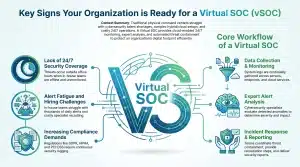
Managed SOC services help companies detect threats early and respond quickly to lessen the effects of hacking attacks, which present serious administrative, financial, and reputational risks. Continuous monitoring and systematic handling of incidents improve resilience while fulfilling environmental and compliance obligations.
Businesses receive a scalable security architecture that adjusts to growth and changing risk profiles by doing away with the requirement for sizable internal security teams, freeing up leadership to confidently concentrate on key business goals.
Overcoming the Fear of Outsourcing IT Security
Data control and privacy issues may arise when security operations are outsourced. Qualified SOC service providers, on the other hand, adhere to stringent security regulations, governance frameworks, and open SLAs. Working with a reliable supplier guarantees access to innovative tools, knowledgeable analysts, and ongoing evaluation without sacrificing data security or governance.
Key Tools and Technologies Businesses Use in Managed SOC Services
Effectively managed soc services rely on a comprehensive security stack. SIEM platforms collect and correlate logs, while SOAR automates incident response workflows. Endpoint and network monitoring tools strengthen soc cyber security by detecting anomalies in real time.
Threat intelligence platforms, vulnerability scanners, log management, and cloud monitoring solutions further enable proactive defense across hybrid environments, ensuring continuous protection against emerging threats.
Choosing the Right Managed SOC Service for Your Business
Aligning security capabilities with business objectives and compliance requirements is necessary when choosing a partner. IBN Technologies provides managed soc services with smooth integration and scalability through fully managed, co-managed, and hybrid engagement models. Proactive threat hunting, vulnerability management, compliance reporting, and a dedicated, round-the-clock SOC manned by skilled analysts are all part of their managed soc platform.
With the support of certifications like SOC 2, ISO 27001, PCI DSS, and HIPAA, IBN Technologies assists businesses in maintaining robust security, regulatory compliance, and continuous operation in an ever more complex digital world.
Act today—partner with IBN Technologies and make Managed SOC Services the backbone of your cyber resilience.
FAQ’s
-
What are managed SOC services?
Managed SOC services involve outsourcing cybersecurity services in which the company’s risks to security are monitored, detected, investigated, and addressed by an outside provider, usually around-the-clock.
-
What are SOC services?
Cybersecurity services known as SOC (Security Operations Center) are centered on constantly observing, identifying, evaluating, and reacting to security risks throughout an organization’s IT infrastructure.
-
What is the difference between managed SOC andin-house SOC?
A managed SOC is when an external provider offers 24/7 security monitoring and incident response, eliminating the need for internal staff or infrastructure. Although it offers complete control, an in-house SOC necessitates a large investment in trained staff, equipment, and continuous operation.
-
What are the benefits of managed SOC?
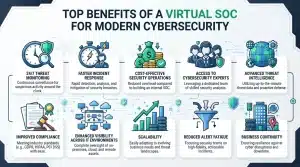
Without requiring an internal SOC, managed SOC services offer scalable protection, skilled security support, quicker attack response, cheaper expenses, and round-the-clock monitoring of security.